Why Emotional Sensitivity Can Increase Without Warning

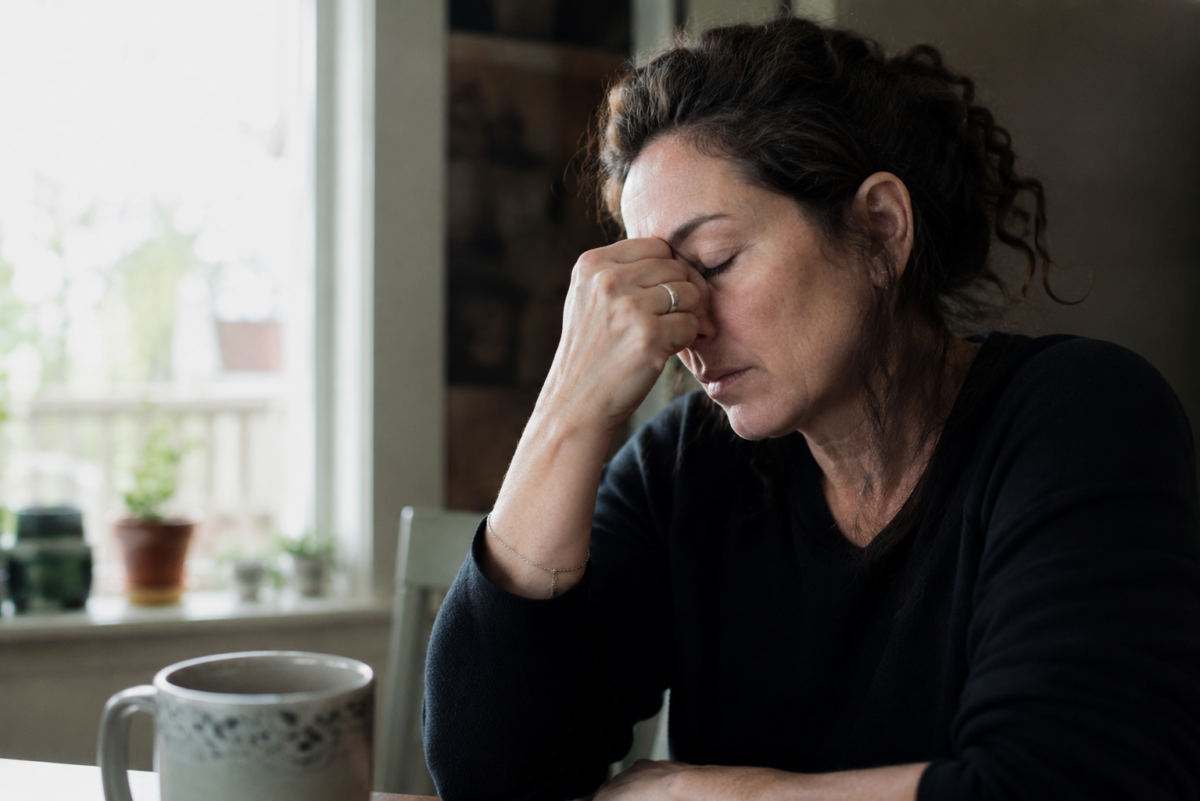
A few months ago, I found myself crying because my husband put a coffee mug in the wrong cabinet.
Not crying after an argument.
Not crying because we’d had a difficult week.
Crying because I opened a cupboard, couldn’t find my favorite mug, and suddenly felt so overwhelmed that I had to walk into another room before I embarrassed myself.
The ridiculousness of it wasn’t lost on me.
I remember standing there thinking, What kind of person cries over a coffee mug?
Apparently, a woman in midlife.
At least that’s what I’ve come to learn.
When people talk about menopause, they usually talk about the obvious things. The hot flashes. The sleep problems. The changes you can point to and say, “There. That’s what’s happening.”
What’s harder to explain is the feeling that your emotions have somehow become less predictable.
Not bigger, exactly.
Closer.
That’s the word I keep coming back to.
Closer.
A sad story doesn’t stay on the other side of the screen anymore. A friend’s disappointment lingers longer than it used to. An offhand comment can sit with you for an entire afternoon even when you know it wasn’t meant the way you heard it.
For a while, I thought this meant I was becoming less resilient.
Many women do.
We’re quick to assume that if we’re crying more easily or feeling things more deeply, something must be wrong.
But lately I’ve started wondering whether the opposite is true.
Maybe the real surprise isn’t that we’re becoming emotional.
Maybe it’s that we’ve spent so many years learning not to be.
Think about how much of adult life is spent pushing feelings aside because there simply isn’t time for them.
You’re raising children.
Building a career.
Looking after parents.
Managing relationships.
Paying bills.
Meeting deadlines.
Keeping everyone fed.
Keeping everyone alive.
There are entire seasons of life where practicality becomes a survival skill.
You don’t ignore your emotions because you’re unhealthy.
You ignore them because dinner still needs to be made.
Then something shifts.
Children grow up.
Parents grow older.
The future starts feeling less endless than it once did.
And somewhere in the middle of all that, feelings that have been patiently waiting in the background begin stepping forward.
Not dramatically.
Not all at once.
Just enough to be noticed.
I’ve heard women describe this in dozens of different ways.
Some say they cry more.
Some say they’re more easily hurt.
Others say they feel softer than they used to.
The word that comes up most often, though, is sensitive.
Usually followed by an apology.
As if sensitivity were evidence of failure.
As if being moved by things is somehow less admirable than being unaffected by them.
Yet the women saying this are often the strongest people I know.
They’re the women everyone else relies on.
The women who show up.
The women who keep going.
The women who have spent decades carrying far more than anyone realizes.
It seems strange to call them fragile simply because they now tear up during a television commercial.
Of course hormones play a role. Sleep plays a role too, and anyone who has stared at the ceiling at three in the morning knows exactly how much harder life feels when you’re exhausted.
But I don’t think biology tells the whole story.
I think some of what we’re experiencing is awareness.
The awareness that time is moving.
The awareness that people we love are aging.
The awareness that certain chapters are ending whether we’re ready or not.
The awareness that our own needs deserve a place at the table after years of sitting quietly in the corner.
None of that is easy.
But neither is it a sign that we’re falling apart.
If anything, it may be a sign that we’re paying attention.
Noticing.
Feeling.
Allowing ourselves to experience things we once rushed past on the way to the next obligation.
Which brings me back to the coffee mug.
The truth is, I wasn’t crying about the mug.
I was tired.
I was overwhelmed.
I was carrying things I hadn’t fully acknowledged.
The missing mug simply happened to be where the feelings finally caught up with me.
And I suspect that’s true for a lot of us.
The tears aren’t always about the thing that triggered them.
They’re often about everything that came before it.
Once I understood that, I stopped worrying quite so much about why I was suddenly emotional.
I stopped treating every tear like a problem that needed solving.
And I started seeing it for what it often was:
A reminder that I’m human.
A little more aware than I used to be.
And perhaps, in its own unexpected way, a little more honest too.