Why Women in Midlife Suddenly Can’t Sleep — Even When They’re Exhausted

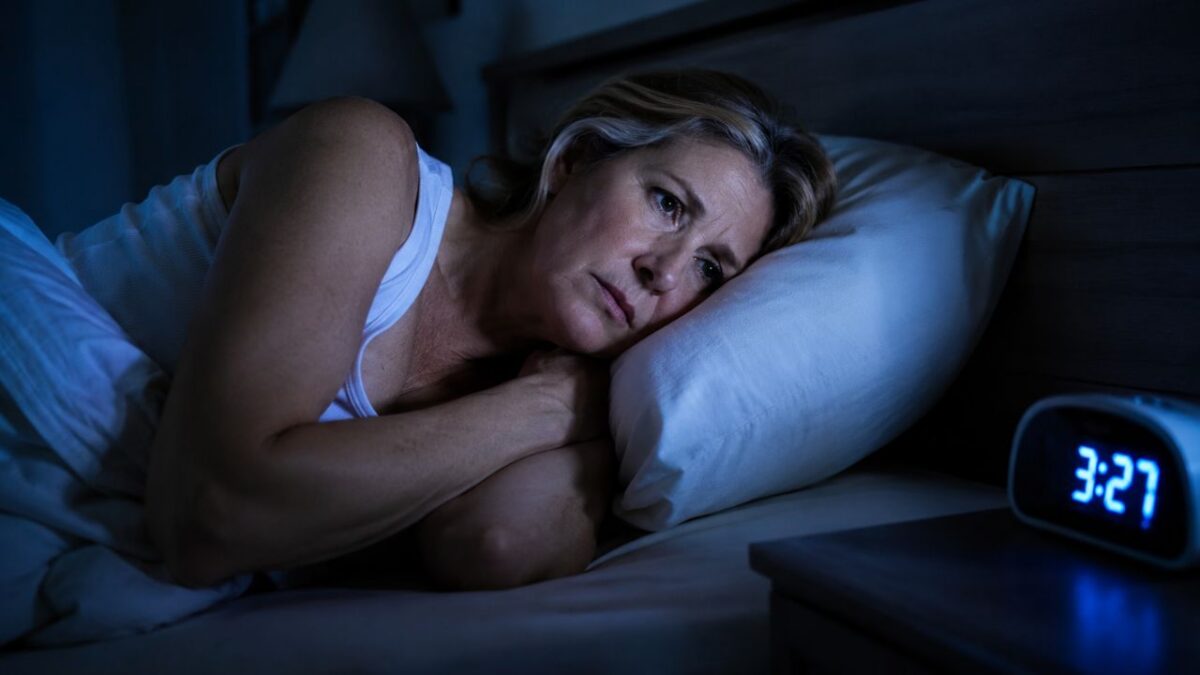
There’s a very specific kind of betrayal that happens in midlife.
You spend the whole day exhausted. You’re counting the minutes until bedtime. You climb into bed thinking, Finally. Sleep.
And then your brain says, “Actually, let’s review every decision you’ve made since 2006.”
Or maybe you fall asleep just fine, but then — ping — you’re awake at 3:17 a.m. Hot. Annoyed. Slightly anxious. Staring at the ceiling while your partner sleeps like a golden retriever with no responsibilities.
If this is happening to you, you are not weird. You are not failing at sleep. And you are definitely not the only woman wondering, What on earth is going on with my body?
Sleep problems are common during perimenopause, menopause, and postmenopause. They can be linked to night sweats, mood changes, stress, aging, sleep disorders, and the very real hormonal shifts happening during this stage of life. The National Institute on Aging notes that hot flashes, night sweats, and mood changes can all contribute to poor sleep during menopause.
First, Let’s Clear Something Up: It’s Not “Just Stress”
Is stress involved? Often, yes.
But saying midlife sleep problems are “just stress” is like saying a kitchen fire is “just a little warm.”
During perimenopause, hormones can fluctuate in a way that affects body temperature, mood, and sleep quality. Mayo Clinic lists sleep problems, night sweats, hot flashes, mood changes, and brain fog among common menopause-transition symptoms, while also noting that symptoms vary from person to person.
So no, you’re not imagining it.
Your body may simply be operating under a new rulebook — one nobody handed you.
The 3 A.M. Wake-Up Club Is Very Real
There should be a group chat for women who wake up between 2 and 4 a.m.
Because somehow, at that hour, your brain becomes both a therapist and a disaster planner.
At 3 a.m., everything feels urgent:
Did I send that email?
Why did I say that thing in 2018?
Are the kids okay?
Should I change my entire career?
Why is my neck sweating?
Middle-of-the-night waking is commonly reported during the menopause transition. Research commentary in The Journal of Clinical Endocrinology & Metabolism notes that sleep disturbances are reported by more than half of midlife women, with middle-of-the-night awakenings especially common as women move through the menopause transition.
That does not mean every 3 a.m. wake-up is caused by hormones. Sleep is more complicated than that. But hormones, stress, temperature changes, and nervous system arousal can all be part of the picture.
Night Sweats Don’t Always Look Like Drenched Sheets
When people talk about night sweats, they often describe the dramatic version: soaked pajamas, soaked sheets, full bedding crisis.
But for many women, it’s subtler.
You might just feel:
too warm, restless, uncomfortable, suddenly awake, or like you need to throw the covers off and then pull them back on five minutes later.
Hot flashes and night sweats can interrupt sleep, and the National Institute on Aging specifically names night sweats as one menopause-related symptom that can make sleep harder.
And once you’re awake, your brain may decide to join the party.
Very unhelpful.
Why Your Usual Habits Suddenly Stop Working
This is the part that feels rude.
The coffee you drank at 4 p.m. for years? Suddenly suspicious.
The glass of wine that used to make you sleepy? Now it helps you fall asleep, then wakes you up at 2:43 a.m. like a tiny chaos goblin.
The late dinner, the scrolling, the stressful email before bed — all the things your younger body used to tolerate may start hitting differently.
That doesn’t mean you have to live like a monk. It just means your body may be more sensitive now.
And honestly, that information can be useful.
Not in a “fix your whole life immediately” way. More like: Hmm, maybe my body is giving me clues.
Let’s Talk About Cortisol Without Turning It Into a Wellness Buzzword
Cortisol gets blamed for everything online, so let’s be careful.
Cortisol is a normal hormone that helps regulate alertness, stress response, and your daily rhythm. It naturally rises in the morning to help you wake up.
The relationship between menopause, sleep, and cortisol is still being studied. One experimental study found that menopause-related sleep disruption, rather than estradiol decline alone, disrupted cortisol dynamics.
So the responsible takeaway is this: stress biology and sleep are connected, but it’s too simplistic to say, “You wake up at 3 a.m. because cortisol is high.” Sometimes that may be part of the story. Sometimes it’s not.
Either way, helping your nervous system wind down in the evening is still a reasonable, low-pressure place to start.
Also, Midlife Women Are Carrying a Lot
Let’s not pretend this is only about hormones.
Many women in midlife are juggling:
work, kids, aging parents, relationships, money stress, body changes, household logistics, health worries, and the invisible job of remembering everything for everyone.
That is not “just life.”
That is a lot.
And when your nervous system spends the whole day in problem-solving mode, it may not magically relax the second your head hits the pillow.
Sometimes the body is basically saying: I have not had one quiet minute all day. We are processing now.
Annoying? Yes.
Understandable? Also yes.
The Sleep Apnea Piece Women Should Know About
Here’s something that deserves more attention: sleep apnea can become more common after menopause, and it may not always look the way people expect.
Many of us think sleep apnea means loud snoring, usually in men. But postmenopausal women can be affected too. A 2025 review in The Lancet Regional Health describes obstructive sleep apnea as common and potentially under-recognized in postmenopausal women, with prevalence rising sharply after menopause.
That doesn’t mean every tired woman has sleep apnea. But if you snore loudly, wake up gasping, have morning headaches, feel extremely sleepy during the day, or your sleep feels unrefreshing no matter what you do, it’s worth bringing up with a healthcare professional.
Practical Things That May Help Without Turning Bedtime Into a Full-Time Job
Nobody needs a 17-step nighttime routine.
You have a life.
Start with small, realistic shifts.
Keep the Room Cooler
A cooler bedroom, lighter bedding, breathable pajamas, or a fan can help if heat is waking you up.
Give Your Brain a Landing Strip
Try 20 minutes of “quiet runway” before bed. Not perfect. Not aesthetic. Just calmer.
Think: reading, stretching, gentle music, journaling, or sitting in dim light without asking your brain to solve your entire life.
Watch Your Personal Triggers
For a week or two, casually notice whether sleep is worse after late caffeine, alcohol, heavy meals, intense evening work, or doomscrolling.
No shame. Just data.
Get Morning Light
Morning light helps your body understand when it’s daytime, which can support your internal sleep-wake rhythm later. It’s simple, free, and doesn’t require buying anything.
Stop Blaming Yourself
This one matters.
Sleep disruption can make you feel emotional, foggy, irritable, and unlike yourself. That does not mean you’re weak. It means you’re tired.
When to Talk to a Healthcare Professional
It’s a good idea to check in with a qualified healthcare professional if sleep problems are persistent, getting worse, or affecting your daily life.
Especially if you have:
loud snoring, gasping during sleep, severe daytime fatigue, ongoing insomnia, intense night sweats, mood changes, morning headaches, or symptoms that feel new or concerning.
Sleep issues can be related to menopause, but they can also involve thyroid changes, mood disorders, sleep apnea, restless legs, medications, pain, or other health factors.
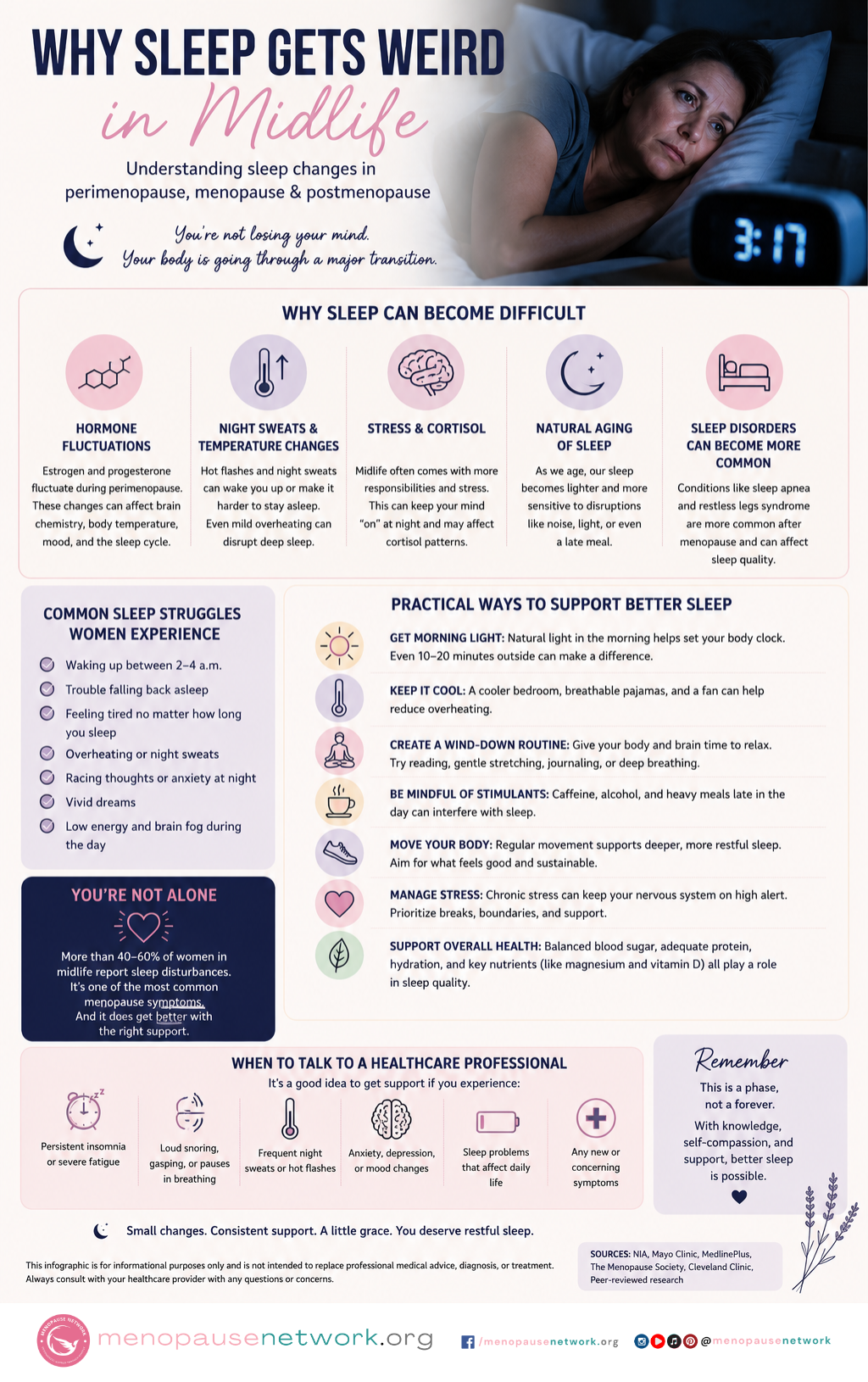
The Bottom Line
If sleep has become strange in midlife, you are not broken.
You are not “bad at sleeping.”
And you are not the only woman lying awake at 3 a.m. wondering why her body has suddenly become so dramatic.
Midlife sleep can change for many reasons: hormones, night sweats, stress, aging, mood shifts, and sleep disorders can all overlap.
The goal is not to panic or chase perfect sleep. The goal is to understand what may be happening, notice your patterns, support your body where you can, and ask for help when something feels persistent or disruptive.
Sometimes the most comforting sentence is also the simplest:
You’re not alone. This is a real thing. And it’s worth paying attention to.
Disclaimer
This article is for informational purposes only and is not intended to replace professional medical advice, diagnosis, or treatment. If sleep problems are persistent, severe, or affecting your quality of life, speak with a qualified healthcare professional.
References
Cleveland Clinic. (2024). Menopause and insomnia: Why sleep problems happen. https://health.clevelandclinic.org/menopause-and-insomnia
Mayo Clinic. (2024). Menopause – Symptoms and causes. https://www.mayoclinic.org/diseases-conditions/menopause/symptoms-causes/syc-20353397
National Institute on Aging. (2023). Sleep problems and menopause: What can I do? U.S. Department of Health and Human Services, National Institutes of Health. https://www.nia.nih.gov/health/menopause/sleep-problems-and-menopause-what-can-i-do
National Library of Medicine. (2024). Menopause. MedlinePlus. https://medlineplus.gov/menopause.html
Shaver, J. L., & Woods, N. F. (2015). Sleep and menopause: A narrative review. Menopause, 22(8), 899–915. https://doi.org/10.1097/GME.0000000000000499
The Menopause Society. (2024). Sleep and menopause. https://menopause.org/patient-education/menopause-topics/sleep-disorders-and-menopause
Vgontzas, A. N., & Fernandez-Mendoza, J. (2023). Sleep, menopause, and cortisol dynamics: Emerging perspectives. The Journal of Clinical Endocrinology & Metabolism, 108(11), e1347–e1358. https://academic.oup.com/jcem/article/108/11/e1347/7174007
Women’s Health Concern. (2025). Menopause and insomnia [Fact sheet]. British Menopause Society. https://www.womens-health-concern.org/wp-content/uploads/2025/08/17-NEW-WHC-FACTSHEET-Menopause-and-Insomnia-AUGUST2025-A.pdf