The Hair, Skin, and Nail Changes That Catch You Off Guard

At first, it’s easy to dismiss.
Your skin suddenly feels tighter after a shower. Your favorite moisturizer no longer seems to “sink in” the way it used to. Your ponytail feels thinner in your hand. Your nails chip while doing the most ordinary things—opening a package, typing on your laptop, washing dishes.
Nothing dramatic. Nothing alarming.
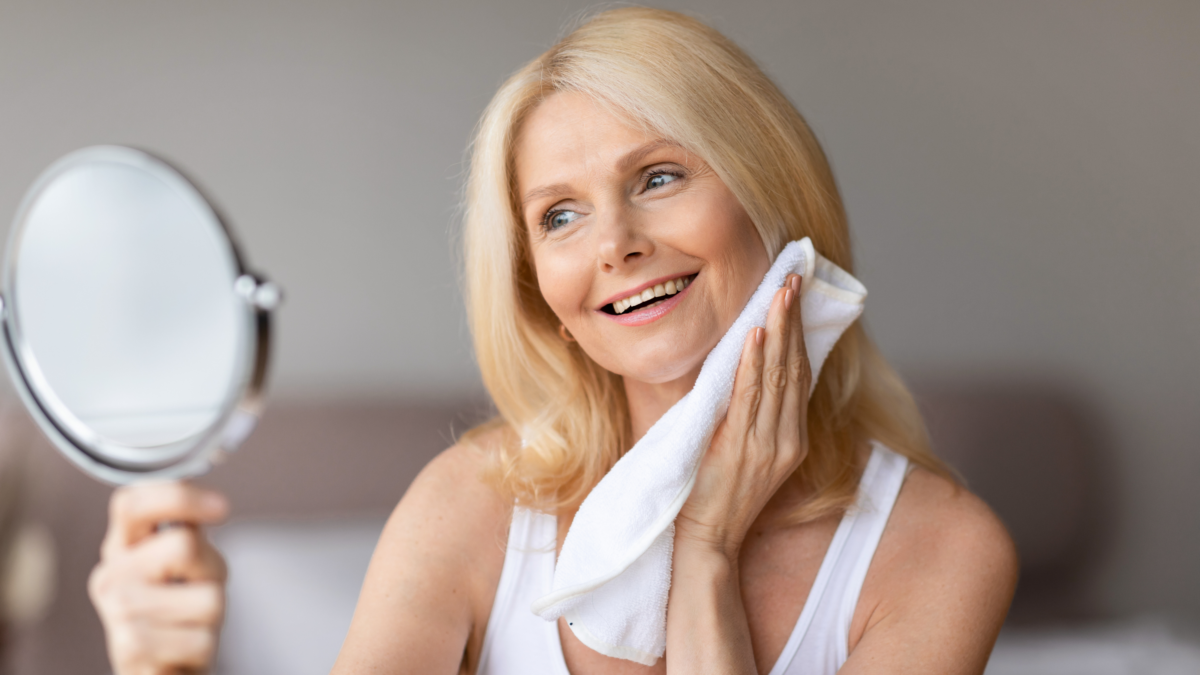
And then one day, usually during some completely ordinary moment, you catch your reflection in the mirror and pause a little longer than usual.
Not because something is wrong.
But because something feels unfamiliar.
For many women and people navigating perimenopause or menopause, that realization can feel surprisingly emotional. Because visible changes hit differently. Hot flashes happen internally. Sleep disruption can remain private. Mood changes are often easier to hide.
But changes in your skin, hair, and nails show up in the face and body you’ve recognized your entire life.
And somehow, nobody really prepares you for that part.
Why Menopause Changes More Than You Expect
When menopause is discussed publicly, the conversation usually revolves around hot flashes, missed periods, mood swings, or sleep disruption. However, many women first notice hormonal changes through something far quieter: their appearance.
The skin that suddenly feels dry no matter how much moisturizer you use. The hair that no longer behaves the same way. The nails that become brittle for reasons you can’t quite explain.
These changes often feel personal because they affect the routines and rituals woven into everyday life. The way your makeup sits on your skin before work. The familiar feel of your hair while tying it up. The confidence attached to looking rested, healthy, and recognizable to yourself.
What makes it even more disorienting is that hormonal shifts tend to happen gradually. Most people don’t wake up one morning looking entirely different. Instead, the changes unfold slowly until eventually, something clicks.
Maybe it happens under harsh department store lighting while trying on foundation. Maybe it’s while pulling your hair into a ponytail before heading out the door and realizing it feels thinner than it used to.
And somewhere in the middle of an ordinary day, a thought quietly appears:
“When did this start happening?”
The Science Behind Menopause Skin Changes
Menopause is far more than the end of menstrual cycles. It’s a major hormonal transition that affects nearly every system in the body—including the skin, scalp, hair follicles, and nails.
One of the biggest shifts involves declining estrogen levels. And estrogen does far more than most people realize.
Researchers published in Dermato-Endocrinology explain that estrogen plays a significant role in collagen production, skin thickness, elasticity, hydration, and wound healing. As estrogen levels decline during menopause, those systems naturally begin changing too.
As a result, many women notice:
- dryness
- reduced firmness
- increased sensitivity
- dullness
- crepey texture
- thinner-looking skin
- slower healing
And unlike the polished language often used in beauty advertising, these changes don’t always feel glamorous or empowering in the moment. Sometimes your skin simply feels unfamiliar.
A moisturizer that once worked perfectly suddenly isn’t enough. Makeup settles differently. Your face may appear more tired even when you’ve rested.
That experience can feel frustrating—not because women expect perfection, but because people naturally notice when something familiar changes.
Why Skin Can Suddenly Feel Older “Overnight”
One of the most confusing parts of menopause is how quickly visible changes can seem to appear.
But in reality, these shifts are usually happening slowly beneath the surface long before they become noticeable in the mirror.
A landmark study published in Obstetrics & Gynecology found that skin collagen decreases significantly after menopause due to estrogen decline. Collagen is part of what gives skin structure, elasticity, and resilience, which helps explain why many women suddenly notice sagging, deeper lines, or thinner-looking skin during midlife.
That’s often why women describe feeling as though they “aged overnight,” even though the hormonal transition itself has been unfolding gradually for years.
At the same time, menopause can make the skin barrier more vulnerable to dryness and irritation. Products that once felt gentle may suddenly feel harsh. Over-exfoliation becomes easier. Skin may react more strongly to weather, stress, or lack of sleep.
This is why many dermatologists recommend shifting away from aggressive “anti-aging” routines during menopause and focusing more on hydration, barrier repair, and consistency instead.
And honestly, there can be something emotionally exhausting about relearning your own skin after decades of familiarity.
Why Hair Changes Can Feel So Emotional
Hair changes during menopause can feel surprisingly personal because hair is deeply connected to identity and self-expression for many women.
Some notice increased shedding in the shower. Others realize their ponytail feels thinner or their part looks wider in certain lighting. Some experience dryness or texture changes they never expected.
A recent systematic review examining menopause-related dermatologic conditions found that hormonal shifts during midlife may contribute to female pattern hair loss, scalp changes, and increased thinning during menopause.
Still, the emotional impact often goes beyond the physical symptom itself.
Hair carries memory and familiarity. Many women have worn their hair the same way for years, sometimes decades. So when texture changes or volume decreases, it can create a quiet sense of disconnect that’s difficult to explain to someone who hasn’t experienced it firsthand.
And unlike temporary bad hair days, hormonal hair changes can feel unpredictable. Smooth hair may suddenly become dry or frizzy. Curly hair may flatten. Straight hair may become coarse or brittle.
At the same time, menopause often overlaps with one of the most demanding phases of life:
- career pressure
- caregiving responsibilities
- aging parents
- financial stress
- chronic sleep disruption
- relationship changes
Taken together, those stressors can affect overall wellbeing, including scalp and hair health.
So if your hair feels different lately, you are not imagining it. Your body is responding to a very real hormonal and physiological transition.
The Small Nail Changes That Quietly Add Up
Compared to skin and hair, nail changes tend to receive far less attention during menopause conversations. Still, they’re incredibly common.
You may notice:
- brittleness
- peeling
- splitting
- ridges
- slower growth
- increased breakage
On their own, these symptoms might seem relatively minor. However, they often become part of a much larger emotional picture.
Because menopause rarely changes just one thing at a time.
Instead, many women experience an accumulation of subtle shifts happening simultaneously. The skin feels drier. The hair behaves differently. The nails become weaker. Over time, those small changes can alter how familiar your body feels to you day-to-day.
And that emotional adjustment deserves more compassion than it often receives.
Why These Changes Affect Confidence More Than People Realize
Many women feel guilty admitting that visible changes affect them emotionally. But appearance and identity have always been deeply connected in human psychology.
The issue usually isn’t vanity.
It’s recognition.
There’s something vulnerable about looking in the mirror and feeling slightly disconnected from the face you’ve known your entire adult life.
Unfortunately, society doesn’t make this easier. Women are constantly given conflicting messages:
Age naturally—but somehow don’t look older.
Accept yourself—but maintain youthfulness effortlessly.
Care about your appearance—but don’t care “too much.”
It’s exhausting.
And somewhere along the way, many women learned to associate visible aging with lost value. That message is both harmful and profoundly untrue.
Because menopause is not a personal failure. It’s not evidence that you’ve “let yourself go.” And it certainly doesn’t erase your beauty, relevance, confidence, or femininity.
Still, emotional adjustment takes time. Especially when the world teaches women to fear visible change instead of understanding it.
What Actually Helps Support Skin, Hair, and Nails During Menopause
The good news is that your body often responds better to support than punishment during this phase of life.
And despite what marketing constantly suggests, supporting menopause-related changes doesn’t require chasing perfection. In fact, gentler and more consistent approaches are often far more effective.
Focus on Hydration and Barrier Support
As skin becomes more vulnerable to dryness during menopause, protecting the skin barrier becomes increasingly important.
That often means:
- gentle cleansers
- hydrating moisturizers
- ceramide-rich products
- reduced over-exfoliation
- daily SPF use
- avoiding overly stripping routines
Research on menopause-related skin health consistently shows that hydration and barrier protection become even more important as estrogen declines.
And while no skincare product can stop aging entirely, supportive routines can absolutely improve comfort, resilience, and overall skin health.
Nourishment Matters More Than Many Women Realize
Sometimes women become so focused on fighting midlife weight changes that they unintentionally undernourish the very systems struggling to stay resilient.
Hair, skin, nails, collagen, and muscle health all rely heavily on adequate nutrition. Protein intake becomes especially important during midlife, yet many women unintentionally under-eat protein while trying to manage changing body composition.
Nutrient deficiencies involving iron, zinc, vitamin D, omega-3s, and B vitamins may also contribute to worsening hair or nail symptoms in some cases.
For that reason, if changes feel sudden or severe, it’s worth discussing bloodwork and nutritional health with a healthcare provider instead of assuming everything is “just menopause.”
Stress and Sleep Affect Appearance Too
This part is often underestimated.
Sleep disruption and chronic stress affect inflammation, hydration, collagen health, hair shedding, skin repair, and cortisol levels.
And because menopause commonly disrupts sleep, many women end up stuck in a frustrating cycle where exhaustion affects both emotional wellbeing and physical appearance.
That’s why nervous system support matters too.
Movement. Rest. Therapy. Stress reduction. Social connection. Consistent sleep habits.
These things aren’t superficial wellness trends. They directly affect overall wellbeing during hormonal transition.
The Pressure to “Look the Same” Is Quietly Hurting Women
One of the quietest forms of suffering during menopause is the belief that women should somehow remain unchanged forever.
Same skin. Same hair. Same body. Same energy.
But human beings were never designed to stay static.
Bodies change. Hormones shift. Sometimes your reflection changes faster than your heart can emotionally catch up.
And while grief around those changes is valid, shame doesn’t have to be part of the experience.
You are not failing because your body changed. You are not less beautiful because your collagen declined. You are not invisible because your appearance evolved.
If anything, this stage of life often invites women to build a new relationship with themselves—one rooted less in perfection and more in compassion.
Maybe that’s the part nobody talks about enough.
Not learning how to “fight” your changing body…
but learning how to finally stand beside it.
When It’s Important to Speak With a Healthcare Professional
Although many skin, hair, and nail changes are considered common during menopause, certain symptoms should still be evaluated medically.
You should consider speaking with a healthcare provider if you experience:
- sudden or patchy hair loss
- painful scalp inflammation
- severe skin irritation
- dramatic nail changes
- symptoms affecting emotional wellbeing or quality of life
Underlying conditions such as thyroid disorders, iron deficiency, autoimmune disease, or nutritional deficiencies can sometimes worsen or mimic menopause-related symptoms.
You deserve support—not dismissal.
And you should never feel pressured to simply “accept” symptoms that are significantly affecting your wellbeing.
You Are Still Yourself <3
The visible changes that come with menopause are often dismissed as cosmetic concerns. Yet for many women, they feel far more personal than that.
Because these changes affect more than appearance. They touch confidence, familiarity, routine, and self-recognition in deeply human ways.
And while adjusting to those changes can feel emotional at times, it does not mean your body is betraying you.
Your body is evolving.
Learning how to support yourself through that evolution—with more compassion, less pressure, and better understanding—can make this phase feel far steadier and far less lonely.
You are still yourself.
Even as your body learns a new language.
Disclaimer: This content is for informational purposes only and is not a substitute for professional medical advice, diagnosis, or treatment. Always consult your healthcare provider before making any decisions about your health, especially related to medication, hormones, or sexual wellbeing. Every woman’s body is different, and what works for one may not work for another.
References
Thornton, M. J. (2013). Estrogens and aging skin. Dermato-Endocrinology, 5(2), 264–270. https://www.tandfonline.com/doi/full/10.4161/derm.23872
Brincat, M., Versi, E., Moniz, C. F., Magos, A., de Trafford, J., & Studd, J. W. (1987). Skin collagen changes in postmenopausal women receiving different regimens of estrogen therapy. Obstetrics & Gynecology, 70(1), 123–127. https://pubmed.ncbi.nlm.nih.gov/3601260/
Flament, F., Jiang, R., Delaunay, C., Kerob, D., Leclerc-Mercier, S., Kosmadaki, M., et al. (2023). Evaluation of adapted dermocosmetic regimens for perimenopausal and menopausal women using an artificial intelligence-based algorithm and quality of life questionnaires: An open observational study. Skin Research and Technology, 29(7). https://onlinelibrary.wiley.com/doi/10.1111/srt.13349
Aldhaheri, S., et al. (2025). Menopause and common dermatoses: A systematic review. https://pmc.ncbi.nlm.nih.gov/articles/PMC12860752/