“I Used to Sleep Fine… Then Suddenly 3AM Became My New Reality”


It’s 2:47AM.
You’re awake. Not fully alert, but not asleep either.
You roll over. Adjust the blanket. Check the clock (again).
Maybe you try to “convince” yourself back to sleep.
Nothing.
And the strangest part?
You didn’t used to be like this.
You were someone who fell asleep easily. Slept through the night. Woke up… rested.
Now? Sleep feels like something you have to work at.
If this sounds familiar, you’re not imagining it—and you’re definitely not alone.
Sleep changes are one of the most quietly disruptive experiences women face in their 30s, 40s, and beyond. They often arrive gradually—so gradually that it’s hard to pinpoint when things shifted.
But over time, a pattern emerges:
- Falling asleep feels harder
- Staying asleep feels unpredictable
- And nighttime starts to feel… different
This isn’t just about “bad sleep habits.”
It’s about real, physiological changes happening beneath the surface.
In fact, research suggests that about 40% to 60% of women report sleep problems during the menopause transition, often including frequent waking during the night.
Let’s talk about what’s actually going on—and how to support your body without turning sleep into another thing you feel like you’re failing at.
When Falling Asleep Stops Feeling Automatic
There was a time when sleep just… happened.
You’d lie down, maybe scroll for a bit, and drift off without thinking.
Now, it’s different.
You lie in bed, and suddenly:
- Your body feels slightly wired
- Your thoughts feel more active
- Sleep doesn’t arrive—it has to be waited for
Recognition Moment #1
You’re tired all day. But the moment your head hits the pillow, your body feels unexpectedly alert.
This shift can feel confusing. You’re not imagining it.
Hormonal shifts during midlife can influence sleep through several pathways—including mood, temperature regulation, and how easily your body transitions into deeper sleep stages.
The Night Wake-Up Pattern So Many Women Recognize
If falling asleep is one challenge, staying asleep is another.
Recognition Moment #2
You wake up between 2AM and 4AM… wide awake.
Not panicked. Not fully energized. Just… awake.
And then:
- You check the time
- Try to go back to sleep
- Feel your frustration slowly build
This pattern is incredibly common in midlife.
Clinical guidance notes that many women experience sleep continuity problems during this stage—meaning waking during the night and having difficulty falling back asleep.
Why Your Body Feels More Alert at the Wrong Time
It feels almost unfair.
You’re exhausted all day…
Then suddenly more alert at night.
This isn’t a personality flaw. It’s biology.
Sleep regulation becomes more complex in midlife. Hormonal changes may affect sleep indirectly—while age-related circadian rhythm shifts can also play a role, sometimes making sleep feel lighter or earlier than it used to.
Recognition Moment #3
You feel a strange second wind at night—like your body picked the wrong time to wake up.
This mismatch can make bedtime feel like a negotiation instead of a natural transition.
The Hidden Role of Temperature and Hormones in Sleep Disruption
Sometimes, it’s not your thoughts waking you up.
It’s your body.
Recognition Moment #4
You wake up slightly too warm. Not drenched, not dramatic—just uncomfortable enough to fully wake you.
Hormonal shifts can affect your body’s ability to regulate temperature. Even subtle changes can disrupt sleep cycles.
Even mild nighttime temperature changes can interrupt sleep quality and make it harder to stay asleep.
Why Your Mind Feels Louder at Night
Nighttime has a way of amplifying things.
During the day, you’re busy. Distracted. Moving.
At night?
Everything gets quiet.
And suddenly:
- Thoughts feel louder
- Worries feel closer
- Small things feel bigger
Recognition Moment #5
You’re not anxious all day—but at night, your mind replays conversations, plans, or concerns you hadn’t thought about earlier.
Hormonal changes, combined with a quieter environment and reduced distractions, can make nighttime feel more mentally active—even when your body is tired.
How to Support Rest Without Forcing Sleep
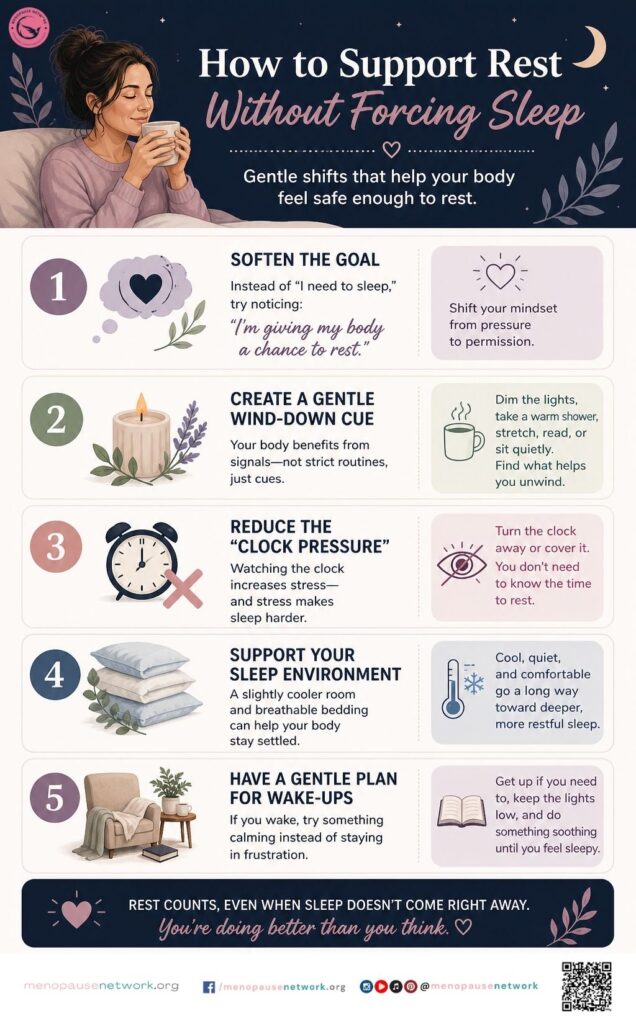
This is where many women get stuck.
They try to fix sleep.
But the more you try to control it, the more pressure builds.
Instead, think of this as supporting rest, not forcing sleep.
1. Soften the Goal
Instead of “I need to sleep,” try noticing:
“I’m giving my body a chance to rest.”
2. Create a Gentle Wind-Down Cue
Your body benefits from signals—not strict routines, just cues.
3. Reduce the “Clock Pressure”
Watching the clock increases stress—and stress makes sleep harder.
4. Support Your Sleep Environment
A slightly cooler room and breathable bedding can help your body stay settled.
5. Have a Gentle Plan for Wake-Ups
If you wake, try something calming instead of staying in frustration.
When Sleep Changes Deserve More Attention
While many sleep changes are common, some deserve a closer look.
Consider talking to a healthcare professional if:
- Sleep disruption is persistent and affecting daily functioning
- You experience frequent night sweats or severe discomfort
- You feel ongoing fatigue, low mood, or brain fog
- You suspect conditions like sleep apnea or chronic insomnia
Sleep is foundational.
You don’t have to simply “push through” if it’s consistently affecting your quality of life.
Takeaway
You didn’t forget how to sleep.
Your body changed.
And while that can feel frustrating—especially when sleep used to come so easily—it doesn’t mean you’re stuck like this forever.
This phase is about learning your body again.
Adjusting, gently.
Supporting instead of forcing.
Some nights will still feel restless.
But others?
They’ll surprise you.
And over time, sleep can start to feel like something that returns—not perfectly, but steadily.
You’re not alone in this.
And there is a way through.
Disclaimer
Menopause Network does not provide medical advice, diagnosis, or treatment. Always seek the advice of your physician or other qualified health provider with any questions you may have regarding a medical condition.
References
British Menopause Society. (2025). Managing sleep disturbance during the menopause transition. https://thebms.org.uk/wp-content/uploads/2025/08/25-NEW-BMS-ToolsforClinicians-Managing-sleep-disturbance-AUGUST2025-A.pdf
Cleveland Clinic. (2024, February 20). Does menopause cause insomnia and sleeplessness? https://health.clevelandclinic.org/menopause-insomnia
Mayo Clinic. (2023). Menopause and insomnia: What you can do. https://www.mayoclinic.org/diseases-conditions/menopause/in-depth/menopause-and-sleep/art-20044620
National Health Service (NHS). (2022). Insomnia. https://www.nhs.uk/conditions/insomnia/