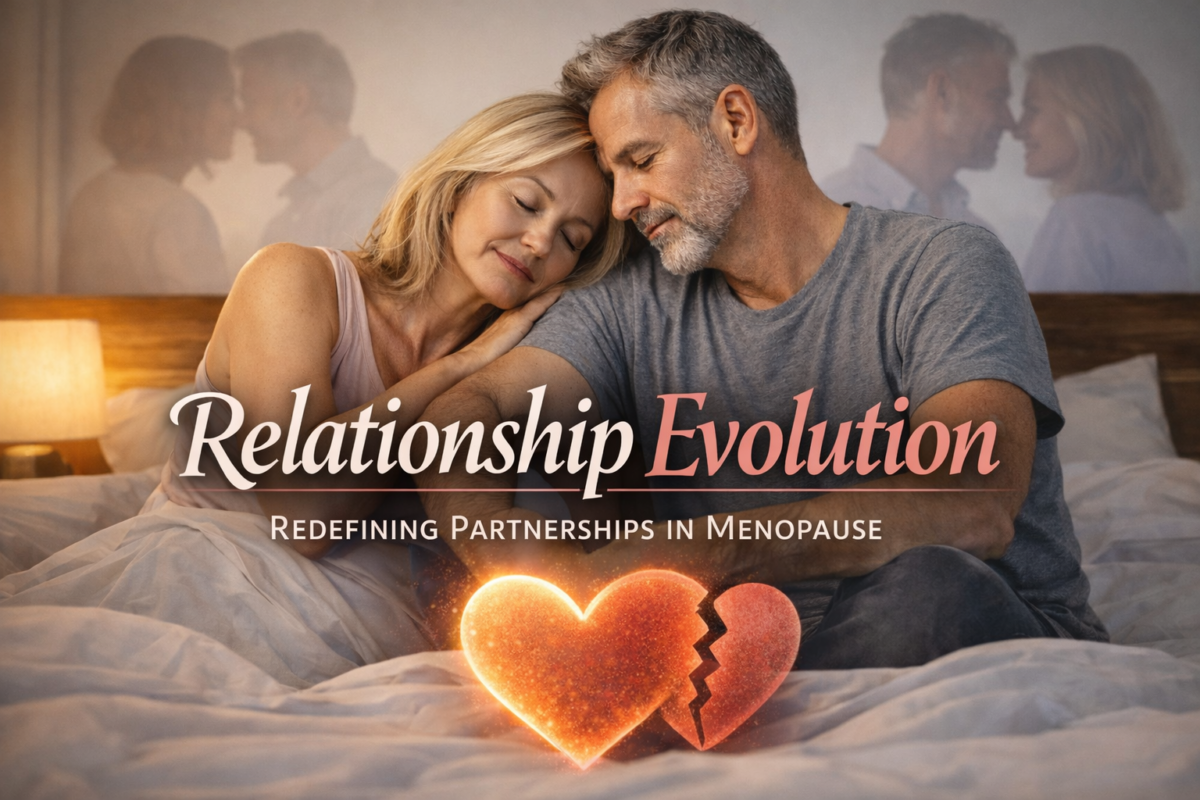
How to Tell Your Partner: “It’s Not You, It’s My Estrogen”

My friend Liza called me one evening, voice shaky, guilt-laced. She said, “Sarah… I feel like a stranger in my own skin. One minute, I’m anxious and weepy, the next, I’m shutting down. Tom (her husband), says I’m snapping at him—like, over nothing—and I feel so disconnected. I don’t even know who I am anymore… He’s getting mad. And I can’t blame him… and I don’t know what to say.”

She hadn’t even considered that estrogen might be her invisible saboteur. All she knew was that she wasn’t herself—and so, she was turning into someone who felt impossible to live with.

Liza’s not alone. Her story is shared by countless women navigating the whirlwind of perimenopause—that period in life when estrogen begins its uneven descent. Emotions flood, sleep tank, libido feels muted, concentration scatters, and energy dives. If you don’t connect the dots, your partner may feel like they’re navigating an emotional minefield… and you may be apologizing for yourself before you even realize what’s at the root of it all.


Perimenopause + Relationship Struggle = Common Storyline

Here’s the truth: perimenopause symptoms can get in the way of emotional availability and connection. And not recognizing them means you’re fishing for faulty conclusions. Mood swings? Not just “stress.” Brain fog? Not just “aging.” Low libido or feeling emotionally detached? Could be changing estrogen—and that’s not your fault.

Many women reach for self-blame: “I’m just stressed, just tired, just… broken.” And their partner hears snapping, distancing, or unexplained irritability—without the who, what, or why. The result? A relationship under strain, with both parties feeling unheard, unseen, and unsure.

So how do we rewrite that script?


“It’s Not You, It’s My Estrogen”

1. Own your experience and sense the change

Start with your gut. Allow yourself to acknowledge that something isn’t you—or at least not the “you” you’ve known until now. Journaling your symptoms (emotional shifts, sleep, libido, brain fog, energy level) helps you connect the dots. The more clarity you have, the more power you bring into the conversation.

2. Pick a calm moment—when both of you aren’t already bruised by argument

Let your partner in when you’re both feeling safe. Say, “Hey, I want to share something important—because I value us, and you’re not the target of my frustration.”

3. Name it

Try something like:

“I’ve been feeling off. Moody, foggy, irritable. And I realize now it’s not because of you—it’s because my estrogen is dropping. I’m likely perimenopausal, and I didn’t even know what that meant until recently.”

Say it gently. You’re not blaming him. You’re revealing something vulnerable—and real.

4. Make it about what needs support—not just what’s going wrong

Examples:

  • Physical support: “I’d love your help with dinner or bedtime routine right now—I’m running on fumes.”
  • Emotional safety: “I need a lot more compassion when I’m foggy or snap at you. It’s not resentment—I’m just hormonally overwhelmed.”
  • Connection: “We haven’t had sex in a while—not because I don’t love you, but I just… feel shut down. Can we find some non-sex intimacy again?”

5. Invite curiosity and learning together

This is your heart inviting his heart into the healing. Say, “I’m going to talk to a hormone-savvy provider and explore what’s going on. Could you help me research? Could we talk about what helps—like how I need to rest or how love looks different in this season?”


Why This Can Be a Game-Changer for Your Relationship

  • It reframes conflict into partnership. You’re saying: “I need YOU more than ever,” not “I’m sick of YOU.”
  • It removes personal blame. Estrogen shifts are real biological phenomena—there’s nothing romantic, sinful, or shameful about them.
  • It paves the way for precision care. When your partner isn’t in the dark, you can create rituals that work for this stage—not the one before.
  • It deepens trust. Vulnerability builds closeness. If this doesn’t bring you closer, then what will?

If you’re reading this and your relationship feels strained by unexplained emotional shifts—you are not broken. You are in a season of hormones talking loud, and you’re learning to listen, bridge, and come back to yourself. That’s brave. That’s smart. And it will bring you closer—to yourself and to love.


Disclaimer: This information is for educational purposes only and is not intended to replace professional medical advice, diagnosis, or treatment. Always consult with your healthcare provider before making any changes to your health routine, especially if you have existing health conditions or are taking medications. What works for one person may not work for another, and your individual health needs are unique to you.

This Is What Happens to Your Skin and Metabolism After 45—And How to Get Your Glow Back

You wake up and something feels different. Your jeans are tighter. Your skin looks a little dull. You’re eating the same, exercising the same—so what gives?

If you’re over 45 and noticing changes in your skin, weight, or energy levels, you’re not imagining it. These shifts are real. And more importantly: they’re not your fault.

This is your body moving through a powerful, natural transition—perimenopause and menopause—and the hormonal shifts underneath are rewriting how your skin looks, how your body stores fat, and how your metabolism functions.

But here’s the good news: when you understand the science behind these changes, you can take back control. You can glow again. You can feel strong, sexy, and clear-headed. This blog shows you how.

Your Hormones After 45: What’s Actually Going On

Starting in your 40s (sometimes even late 30s), your estrogen and progesterone levels begin to fluctuate. Eventually, they decline. Here’s what that means:

  • Estrogen helps your skin stay plump and hydrated, supports collagen production, boosts mood, and keeps fat distribution balanced.
  • Progesterone helps you sleep, calms your nervous system, and supports metabolic health.

When these drop, you may notice:

  • Weight gain, especially around your belly
  • Thinning, drier skin
  • Mood swings or brain fog
  • Sluggish metabolism

These aren’t signs of failure—they’re biochemical changes. Your body is responding to a new hormonal environment. But you’re not powerless.

Your Skin: Why It Feels Like It Aged Overnight

The Truth About Estrogen and Skin

Estrogen receptors are literally embedded in your skin. When estrogen dips:

  • Collagen drops by up to 30% in the first 5 years after menopause ([Source: JAMA Dermatology])
  • Skin becomes thinner and more fragile
  • Hydration and elasticity decline

You might see more wrinkles, sagging, and dullness—even if your skincare routine hasn’t changed.

What You Can Do About It

1. Upgrade your skincare routine:

  • Use a gentle, creamy cleanser.
  • Add a hydrating serum with hyaluronic acid.
  • Moisturize with ceramides and peptides.
  • Use SPF daily (non-negotiable).
  • Consider bakuchiol or retinol (if tolerated) to boost collagen.

2. Support your skin from within:

  • Eat foods rich in omega-3s (salmon, walnuts, flaxseed).
  • Prioritize protein and antioxidants.
  • Sleep 7–9 hours per night—this is when skin repairs.

3. Talk to your doctor:

  • Topical estrogen therapy may help rejuvenate skin (prescription only).

Why You Might Be Gaining Weight (Even if You’re Doing Everything “Right”)

The Estrogen-Metabolism Connection

Estrogen helps regulate:

  • Insulin sensitivity (how your body handles sugar)
  • Fat storage
  • Muscle mass

When it declines:

  • You become more insulin resistant
  • Fat shifts to your abdomen
  • Muscle mass declines (which slows metabolism even more)

What You Can Do

1. Strength train 2–3x/week:

  • Builds lean muscle
  • Boosts metabolism
  • Improves insulin sensitivity

2. Prioritize protein at every meal:

  • Aim for 20–30 grams per meal
  • Helps preserve muscle and keeps you full

3. Balance carbs and fats:

  • Focus on whole carbs (veggies, legumes, whole grains)
  • Add healthy fats (avocado, nuts, olive oil)

4. Reduce stress:

  • High cortisol = more fat storage and muscle breakdown
  • Use breathwork, walking, journaling, or nature to reset

5. Sleep is non-negotiable:

  • Less sleep = more cravings and worse insulin response

The Brain Fog, Mood Swings, and “Flatness”

Hormones don’t just affect your body—they shape your brain chemistry too.

  • Less estrogen = less serotonin and dopamine
  • Cortisol rises, making anxiety and low mood worse

Strategies that help:

  • Omega-3s for brain health
  • Magnesium glycinate for calming
  • Rhodiola or ashwagandha (adaptogens)
  • Social connection (oxytocin boost!)
  • Mind-body practices: yoga, tai chi, meditation

Your Glow-Back Game Plan

Daily Routine for Radiance

Morning:

  • Wake and hydrate (water + lemon)
  • Gentle movement or walk
  • Protein-packed breakfast (e.g. eggs + greens + avocado)
  • Skincare: Cleanse + serum + moisturizer + SPF

Midday:

  • Strength workout or brisk walk
  • Protein-rich lunch + colorful veggies
  • Deep breathing break or gratitude journaling

Evening:

  • Light, early dinner with protein and healthy fat
  • Skincare wind-down (cleanse, nourish, hydrate)
  • Screen-free time + herbal tea
  • In bed by 10 p.m.

You’re Not Broken. You’re Evolving.

You are not the problem. Your hormones are changing—but now you have the power to support your body in a new way.

This isn’t about “anti-aging.”

This is about pro-vitality. Pro-energy. Pro-you.

Share this with your girlfriends. Let them know they’re not alone. Let’s change the conversation about menopause and help each other glow through the years ahead.


Please remember: This information is for educational purposes only and is not intended to replace professional medical advice, diagnosis, or treatment. Always consult with your healthcare provider before making any changes to your health routine, especially if you have existing health conditions or are taking medications. What works for one person may not work for another, and your individual health needs are unique to you.

Prevention Starts Now: Healthy Aging in Perimenopause

The Quiet Moment That Changes Everything

It usually doesn’t start with a diagnosis.

It starts with a whisper. A flicker of fatigue that lingers too long. A forgotten word mid-sentence. A night drenched in sweat that feels more like panic than temperature. For many women, perimenopause doesn’t arrive with sirens—it tiptoes in, disguised as stress or aging or “just one of those weeks.”

Imagine her: 46 years old. A leader at work, the emotional anchor at home, someone who’s always had her routines down to a science. But lately, her body doesn’t respond the same. Her workouts feel harder. Her heart seems to race after a single flight of stairs. And her sleep—once solid—is now fragile, interrupted by flashes of heat and waves of inexplicable anxiety.

She tells herself it’s fine. Just hormones. Nothing she can’t handle.

What she doesn’t realize—what so many women aren’t told—is that this is the beginning of one of the most critical health transitions of her life.

Perimenopause is not just about symptoms—it’s a window of opportunity. A pivotal period where small, intentional choices can create a ripple effect across decades. It’s a time when bone density silently begins to decline, when cardiovascular risk edges upward, when cancer screenings become more urgent—not because she’s aging, but because her biology is shifting in powerful, invisible ways.

And the truth is: by the time most women are told to “start thinking about prevention,” they’ve already missed the most influential moment.

That moment is now.

This article is your roadmap to healthy aging in perimenopause—starting with the three pillars every woman deserves to understand and act on: bone health, heart disease prevention, and cancer screening. Backed by the latest research and rooted in what women actually experience, we’ll walk through not just the why, but the how. Because the goal isn’t just to survive perimenopause.

It’s to thrive into the decades beyond it—with strength, clarity, and the kind of fierce, preventive power that begins the moment you decide it’s time.

And it is time.


Bone Health – Strength Beneath the Surface

You don’t feel your bones getting weaker. There are no warning lights, no aches that signal a silent loss. And yet, in the three to five years surrounding menopause, women can lose up to 20% of their bone density. Let that sink in: one-fifth of the very structure holding you up can disappear—before you even reach your last period.

This isn’t fear-mongering. It’s biological fact.

Why Bone Health Matters More Than Ever

Your bones aren’t just architecture. They’re active, living tissue—and during perimenopause, the hormonal shifts (especially the decline in estrogen) speed up the natural process of bone breakdown. This leads to osteopenia and eventually osteoporosis, dramatically increasing your risk of fractures.

And a fracture in midlife isn’t just inconvenient. A hip fracture can take away your independence. In the year following a hip break, 20% of women die, and more than half never regain full mobility. (Cleveland Clinic, 2022)

The Critical Window for Prevention

Here’s the truth the standard guidelines rarely mention: bone loss begins before menopause ends. The SWAN (Study of Women’s Health Across the Nation) study found that spinal bone density can drop by 2.5% per year in late perimenopause.

And yet, most doctors don’t recommend a bone density scan (DEXA) until you’re 65.

That’s too late.

If you’re in your 40s or early 50s, and you have risk factors like low body weight, a history of fractures, smoking, or early menopause—you need to advocate for earlier screening. (Bonza Health, 2025)

What You Can Do Today

1. Push for a DEXA scan
If you’re in midlife with risk factors, ask your doctor. Be persistent. This scan is painless, fast, and incredibly revealing.

2. Move with purpose
Weight-bearing exercises like brisk walking, dancing, hiking, or strength training aren’t just good for your mood. They tell your bones, “Stay strong.”

3. Feed your frame
Make sure you’re getting enough calcium (1,000–1,200 mg/day) and vitamin D (600–800 IU/day), ideally through food but with supplements if needed.

4. Consider hormone therapy
Estrogen replacement can help slow bone loss—especially in women with early menopause or those at high risk of osteoporosis. It’s not for everyone, but it’s worth a nuanced conversation with your provider.

5. Know your numbers
Ask about FRAX—a tool that calculates your 10-year fracture risk. If your score is high, medications like bisphosphonates or anabolic agents may be necessary.

Bone loss isn’t inevitable. But if you wait until you feel it, it may already be too late. The time to build strength beneath the surface is now.


Cardiovascular Prevention – Your Heart, Reimagined

For decades, estrogen acted like an invisible bodyguard for your heart. It helped keep blood vessels flexible, supported healthy cholesterol levels, and offered protection against cardiovascular disease. But as estrogen begins to decline in perimenopause, that natural defense fades—and your heart notices.

Why Heart Health Deserves Center Stage

Heart disease is the number one killer of women. It doesn’t announce itself with drama. For many, it arrives subtly—with fatigue, indigestion, or shortness of breath that’s easy to dismiss. But underneath those signs, risk factors are quietly stacking up.

Blood pressure creeps higher. Cholesterol starts to shift. Metabolism slows. And when these changes go unchecked, they create the perfect storm for future heart attacks or strokes.

The Midlife Shift

Perimenopause is a tipping point. It’s when doctors should begin regularly screening you for:

  • Blood pressure
  • Fasting blood glucose
  • Lipid panel (cholesterol)
  • Weight and waist circumference
  • 10-year cardiovascular risk (using tools like ASCVD Risk Estimator)

If these aren’t part of your regular care, it’s time to ask for them. Prevention isn’t just about tracking numbers—it’s about reclaiming your health narrative.

What You Can Do Today

1. Know your numbers
Get a baseline of your blood pressure, cholesterol, and glucose. Then check in yearly.

2. Redesign your plate
A Mediterranean-style diet rich in vegetables, healthy fats, whole grains, and lean protein supports both heart and hormonal health.

3. Make movement non-negotiable
Even 30 minutes a day of moderate exercise reduces heart disease risk, improves mood, and helps with weight maintenance.

4. Manage stress and sleep
Chronic stress and poor sleep can both raise cortisol levels and increase cardiovascular risk. Don’t treat rest like a luxury—it’s foundational.

5. Talk to your provider about HRT
While HRT is not universally recommended for cardiovascular prevention, starting it within 10 years of menopause or before age 60 may offer heart benefits for some women.

Your heart deserves as much attention as your hormones. And with the right steps, you can keep it strong for the long haul.


Cancer Screening – Early Eyes, Lifesaving Impact

Perimenopause isn’t just a time of shifting cycles—it’s also when cancer risk begins to change. While not every woman will face cancer, the likelihood increases with age. The good news? Early detection saves lives.

The Screenings That Matter Now

1. Breast Cancer

  • Start annual or biennial mammograms at age 40 if average risk.
  • If you have a family history of breast cancer or dense breast tissue, talk to your doctor about earlier or additional screening like 3D mammography or MRI.

2. Cervical Cancer

  • Continue Pap smears every 3 years, or every 5 years with HPV co-testing.
  • You can stop screening at 65 only if you’ve had adequate normal results previously.

3. Colorectal Cancer

  • Start screening at age 45, earlier if you have risk factors.
  • Options include colonoscopy (every 10 years), FIT test (yearly), or Cologuard (every 3 years).

4. Lung Cancer

  • If you’re a current or former smoker (20 pack-year history, age 50-80), ask about low-dose CT screening.

What You Can Do Today

1. Know your family history
Share this with your doctor—it can change your screening recommendations.

2. Schedule overdue appointments
Many women delay screenings. Don’t. Early detection leads to early action.

3. Ask about risk-based screening
Not all cancers are one-size-fits-all. Ask about personal risk assessments, especially for breast and ovarian cancers.

Cancer screening is a proactive act of self-respect. It doesn’t just protect your life—it honors it.


Your Healthy Aging Assessment Checklist

This checklist isn’t overwhelming—it’s empowering. Use it as a conversation starter with your healthcare provider or as a private wake-up call.

BONE HEALTH

  • DEXA scan (if risk factors)
  • Calcium + vitamin D intake
  • Weight-bearing and resistance exercise
  • HRT discussion (if applicable)
  • FRAX score calculation

CARDIOVASCULAR HEALTH

  • Blood pressure check
  • Cholesterol and glucose labs
  • Weight and waist circumference
  • Daily movement routine
  • Sleep and stress management
  • Mediterranean-style eating pattern
  • Cardiovascular risk calculation
  • HRT discussion for heart health (if appropriate)

CANCER SCREENING

  • Mammogram
  • Pap smear/HPV test
  • Colonoscopy/FIT/Cologuard
  • Lung CT (if smoker/former smoker)
  • Family history assessment
  • Personalized risk discussion (e.g., BRCA, Lynch syndrome)

LIFESTYLE + WELLBEING

  • Nutrition check-in (adequate protein, fiber, micronutrients)
  • Alcohol and smoking habits review
  • Mental health screening (mood, anxiety, social support)
  • Sleep quality assessment
  • Stress-reduction plan (yoga, therapy, mindfulness)

Prevention is Power

Perimenopause is not a pause—it’s a pivot. And what you do in this chapter determines how strong, vibrant, and empowered your next one will be.

This is your invitation to stop waiting for things to get worse.

This is your moment to get stronger, smarter, and more self-aware than ever.

Start now.

Because aging well isn’t luck.

It’s a choice.

And today, that choice is yours.


Disclaimer

This article is for informational and educational purposes only. It is not intended to serve as a substitute for professional medical advice, diagnosis, or treatment. Always consult with a qualified healthcare provider regarding any questions you may have about a medical condition or health goals. Never disregard professional medical advice or delay seeking care because of something you have read here.


References

American Academy of Family Physicians. (2025). Health maintenance in postmenopausal women. American Family Physician. https://www.aafp.org/pubs/afp/issues/2025/0500/health-maintenance-postmenopausal-women.html

American College of Obstetricians and Gynecologists. (2021). Osteoporosis prevention, screening, and diagnosis: ACOG clinical practice guideline number 1. https://www.acog.org/clinical/clinical-guidance/clinical-practice-guideline/articles/2021/09/osteoporosis-prevention-screening-and-diagnosis

Bonza Health. (2025, June 17). DEXA scans in perimenopausal women: The case for earlier bone health screening. https://www.bonzahealth.com/blog/dexa-scans-in-perimenopausal-women-the-case-for-earlier-bone-health-screening

Cleveland Clinic. (2022, March 15). Osteoporosis and menopause: What you need to know. Cleveland Clinic Health Essentials. https://health.clevelandclinic.org/osteoporosis-and-menopause

Cleveland Clinic. (n.d.). DEXA (DXA) scan: Bone density test. https://my.clevelandclinic.org/health/diagnostics/10683-dexa-dxa-scan-bone-density-test

Hopkins Medicine. (2025). Navigating perimenopause: 5 tips from a women’s health provider. https://www.hopkinsmedicine.org/health/wellness-and-prevention/navigating-perimenopause-5-tips-from-a-womens-health-provider

Mahannah, K. (2023). How to prevent osteoporosis in perimenopause and menopause. Dr. Kathleen Mahannah. https://drkathleenmahannah.com/blog/osteoporosis-prevention

Nash, Z., Al-Wattar, B. H., & Davies, M. C. (2022). Bone and cardiovascular health in menopausal women. Best Practice & Research Clinical Obstetrics & Gynaecology, 81, 61–68. https://doi.org/10.1016/j.bpobgyn.2022.04.002

Women’s Health Initiative. (n.d.). Women’s Health Initiative (WHI). Wikipedia. https://en.wikipedia.org/wiki/Women%27s_Health_Initiative

Take Control: Become Your Own Health Advocate in Perimenopause!

Let me be clear: navigating perimenopause isn’t just about managing hot flashes and mood swings. It’s about reclaiming your power. For too long, women have been told to accept feeling foggy, tired, anxious, or dismissed when they bring these concerns to their doctor. I’m here to tell you: that ends now.

Being your own health advocate is no longer optional—it’s essential. If you’re in your 30s, 40s, or early 50s and something feels off, don’t wait for validation. This is your moment to speak up, ask questions, and demand the care you deserve. Here’s how to do it.

Why Advocacy Matters More Than Ever in Perimenopause

Perimenopause affects over 2 million women in the U.S. alone every year—yet it’s still wildly underdiagnosed and misunderstood. According to The Menopause Society, most healthcare providers receive minimal training on menopause and perimenopause in medical school. That lack of education has real consequences: your symptoms might be dismissed, misdiagnosed, or worse, ignored.

Advocacy isn’t about confrontation. It’s about collaboration. When you take an active role in your care, studies show you’re more likely to receive appropriate treatment and experience better health outcomes.

Prepare Like a Pro for Your Appointments

Going to your doctor shouldn’t feel like preparing for battle, but let’s be honest—sometimes it does. Here’s how to get the most from your visit:

  • Track your symptoms: Keep a journal or app documenting changes in sleep, mood, cycle, libido, weight, and energy. Bring that data.
  • Prioritize your top concerns: Choose your top 3 symptoms or questions to focus the conversation.
  • State your goals: Whether you want to explore natural solutions, hormone therapy, or lifestyle changes, be upfront.
  • Know your history: Come prepared with your family medical history and past hormone-related experiences.

And remember: it’s okay to say, “I’d like to explore other options. Can you walk me through them?”

Ask the Right Questions

Don’t leave your appointment feeling more confused than when you arrived. Ask clear, direct questions that demand real answers. Here’s how—and why it matters:

A great example comes from Halle Berry. At age 54, after experiencing painful intercourse, her doctor misdiagnosed her with herpes—calling it “the worst case he’d ever seen.” Both she and her partner tested negative. Only later did she realize vaginal dryness—a common perimenopausal symptom—was the real cause. That experience sparked her powerful advocacy for menopause awareness. (EW)

And it doesn’t stop there. Even Oprah Winfrey shared that her perimenopausal symptoms, including heart palpitations and intense brain fog, left her terrified she had a serious cardiac condition or early dementia. Her doctor didn’t initially connect the dots. It wasn’t until a chance conversation with a menopause specialist that she finally got the right diagnosis and support. (Allure)

That’s exactly why you need to come prepared. These are the questions I recommend:

  1. Could my symptoms be related to perimenopause?
  2. What tests do you recommend to evaluate my hormone health?
  3. Are there effective non-hormonal treatments I should explore?
  4. What are the pros and cons of hormone therapy given my personal history?
  5. How often should we monitor hormone levels during this transition?
  6. What lifestyle changes or integrative options might support me?
  7. Can you refer me to a certified menopause or perimenopause specialist if needed?

If your provider seems rushed, dismissive, or unsure, that’s your cue to explore a second opinion.

Don’t Ignore Red Flags

You are not “too young.”
You are not “just stressed.”
You are not “imagining it.”

Dismissive comments like these are classic signs of medical gaslighting. If your provider minimizes your concerns or tells you to “wait it out,” it’s time to pivot.

According to the 2024 Kaiser Family Foundation (KFF) Women’s Health Survey, 29% of women reported that their concerns were dismissed, and 38% experienced at least one negative interaction with a provider, including being disbelieved or blamed. These experiences are linked with delayed care and worse health outcomes. Your doctor should be your partner—not your gatekeeper.

Normalize Getting a Second Opinion

Here’s a secret many women don’t hear enough: getting a second opinion is smart, not disrespectful. It means you’re invested in your health. Especially with something as nuanced as perimenopause, you deserve comprehensive care.

Use directories like The Menopause Society (formerly NAMS) to find certified menopause practitioners. Ask friends or local women’s health groups for referrals. And don’t be afraid to vet your provider’s knowledge.

You Deserve More Than a 10-Minute Visit

If your provider isn’t taking the time to listen, educate, and collaborate with you, that’s not real care. You deserve:

  • Longer appointment windows
  • Follow-up care and lab review
  • Shared decision-making
  • Respect for your preferences, whether natural or pharmaceutical

When a provider takes the time to explore why you’re experiencing symptoms rather than just writing a prescription, everything changes. That’s root-cause medicine. That’s what you deserve.


Bonus: Download Your Free Healthcare Advocacy Worksheet

Ready to lead your next doctor visit with clarity and confidence? Download my Healthcare Advocacy Worksheet. It helps you:

  • Log your most important symptoms
  • Clarify your health goals
  • List smart questions for your provider
  • Decide when to seek a second opinion

Download the Worksheet Now


This is your body, your experience, and your future.

Perimenopause doesn’t get to sideline your power. You do not have to feel lost, dismissed, or out of control. You get to own this transition—and transform it into a time of renewed strength, clarity, and vitality.

You’re not just going through perimenopause. You’re stepping into your authority.


Please remember: This information is for educational purposes only and is not intended to replace professional medical advice, diagnosis, or treatment. Always consult with your healthcare provider before making any changes to your health routine, especially if you have existing health conditions or are taking medications. What works for one person may not work for another, and your individual health needs are unique to you.


References

Wegrzynowicz, A. K., Walls, A. C., Godfrey, M., & Beckley, A. (2025). Insights into Perimenopause: A Survey of Perceptions, Opinions on Treatment, and Potential Approaches. Women (Basel, Switzerland)5(1), 4. https://doi.org/10.3390/women5010004

Berry, H. (2024, May 1). Halle Berry says doctor misdiagnosed her perimenopause symptoms as herpes. Entertainment Weekly. https://ew.com/halle-berry-doctor-misdiagnosed-perimenopause-herpes-8620647

Winfrey, O. (2024, March 15). Oprah shares her misdiagnosis journey through perimenopause. Allure. https://www.allure.com/story/oprah-winfrey-menopause-symptoms

The Menopause Society. (n.d.). Choosing a healthcare practitioner. https://menopause.org/patient-education/choosing-a-healthcare-practitioner

Kaiser Family Foundation. (2024). A closer look at negative interactions experienced by women in health settings: Findings from the 2024 women’s health survey. KFF. https://www.kff.org/womens-health-policy/a-closer-look-at-negative-interactions-experienced-by-women-in-health-settings-findings-from-the-2024-womens-health-survey/

Redefining YOU: What Happens When Menopause and Motherhood Both Let Go

Hey friend — let’s talk truthfully, tenderly, and with unflinching honesty about what’s happening when Empty Nest Syndrome meets perimenopause.

That time when your body’s whispering that it’s changing, and your home feels different, too—the children are growing up and moving forward, leaving a quiet that echoes deeper than before.

I’ll walk with you through every twist: those identity tremors, the rush of grief, the shadows of loss, and the surprising flashes of freedom and reinvention. By the time we’re done, you’ll have a roadmap—not an airy promise, but real, tangible steps—the Empty Nest Adjustment Guide—to help you lean into this double transition with your heart full of clarity, purpose, and hope.

Let’s dive in.


WHY THIS MOMENT FEELS SO…GIANT

Your Body Is Speaking a New Language

There’s a hormonal uproar happening. Estrogen, progesterone, all the familiar players are changing their tune—sometimes whispering, sometimes roaring—that something big is shifting inside. This isn’t just about hot flashes or changed cycles (though those are real and impactful) — it’s about your body telling you, “You’re crossing into new territory.”

Your Home Feels a Little…echo-y

Your kids are moving out (or getting ready to), and suddenly the home you’ve known morphs. That space—once humming with routines, laughter, late-night secrets—feels different. You’re holding the weight of absence, and maybe wondering, “Who am I if not mom to them?”

Two Transitions, One Emotional Wave

When perimenopause and empty nesting happen around the same time, every emotion—sadness, relief, restlessness—gets amplified. It’s like riding two waves at once: one reshapes your body, the other, your purpose.


1. IDENTITY SHIFTS: RECLAIM WHO YOU ARE, WHO YOU’RE BECOMING

A. Acknowledge the Loss (and the Beauty)

You’re not just letting go of roles. You’re saying goodbye (part of the time) to:

  • The full-time caregiver, the breakfast chef, the school-run coordinator…
  • The long evenings of homework help and school projects
  • The constant question of “What will your kid do next?”

Grieving this is okay. Let it be messy. Tearful. Honest.

But there’s also this: the space that opens up is invitation. This is where “You” — the version of yourself beyond mom-mode — gets to step forward.

B. Remember Who You Were Before

You’re more than a role—you are multitudes.

  • Maybe you loved painting, writing, hiking, dancing, lost for a while among schedules.
  • Maybe there was art, music, connection, or causes you once championed you want to revisit.

Here’s your permission slip to reach back for that girl. Say her name. Invite her back.

C. Explore, Experiment, Expand

Your identity reframe doesn’t need to happen all at once. Try one new seed:

  • Volunteer with a cause that matters to you (e.g. women’s health, climate, local theater)
  • Start a blog or memoir project—tell the stories you’ve lived
  • Learn a skill you’ve always admired—guitar, photography, writing, crafting your own path

Repeat: this isn’t “finding yourself” (as if you’ve been lost). It’s rediscovering the self beneath the titles.


2. GRIEF PROCESSING: LET THE SADNESS AND STRENGTH COEXIST

A. The Emotional Truths

There’s grief here—real, rich, and valid. And there’s also—

  • Relief (no running out to soccer practice)
  • Excitement for new relationships and rhythms
  • Guilt: “Am I supposed to feel thrilled right now?”

Let those emotions all breathe. There’s no map that says you have to only grieve or only celebrate.

B. Rituals That Comfort

Sometimes, we disarm grief with tiny rituals:

  1. Memory Jar: Write one memory with your child, drop it in a jar. Open it on days you’re feeling lost.
  2. Letter to Your Younger Self: Speak from where you are now—what would you tell her about resilience, love, imperfection?
  3. Keepsake Box: A special container for mementos of this mom-child chapter (notes, drawings, photographs, special trinkets).

Grief isn’t meant to be banished—it’s meant to be felt, honored, then transformed.

C. Let Others In

Sometimes, grief lands in silent isolation. Hunt for connections:

  • Online forums or communities for peri- and menopausal women
  • Support groups for parents moving through the empty-nest transition
  • Close friends who let you cry… and laugh again… without judgment

Even reading a blog like this lets you know: you’re not alone. And you never have to be.


3. NEW OPPORTUNITIES: WHAT YOU’VE WON

A. Space Is a Gift

That quiet house? It’s your sanctuary now:

  • Morning silence that lets you practice mindfulness, yoga, journaling
  • Evenings filled with soft music, new recipes, cuddles with your partner, or no plan at all
  • A solo weekend getaway (or weekday!) — just because

What does freedom taste like today? Dare to define it.

B. Reinventing Rituals with Intention

Kids may have left, but tradition can be reborn:

  • Make yourself a Sunday ritual—a long personal brunch, a walk with a friend, a journal session with candles
  • Start “Me-time Monday”—choose something just for you: a podcast, a bath, a dance spontaneous
  • Find or create a women’s circle—a weekly/monthly gathering where you share, learn, and lean

These rituals say: “I matter, my joy matters.”

C. Create Legacy On Your Terms

You’re not in transition; you’re entering a new phase of authoring your life:

  • Write—an essay, a novel, a motherhood memoir
  • Advocate—for women’s health, for perimenopause, for better resources for transitioning mothers
  • Learn—start that book club, take online courses, enroll in evening classes

Your experience equips you to lead, teach, inspire.


4. THE SCIENCE BEHIND THE EMOTIONAL SEA

Let’s anchor all this heart talk in research, gently:

  • Mindfulness and journaling can help reduce perimenopausal mood swings and anxiety, reframing identity shifts as opportunities for growth.
  • Researchers have found that women who consciously foster new social or creative roles after becoming empty nesters report increased satisfaction, lower depression, and better self-esteem.
  • “Transition rituals” — even small ones — can help your brain feel anchored during emotional upheaval.

Translation? This messiness you’re wading through? It’s fertile ground for reinvention, not derailment.


5. THE EMPTY‑NEST ADJUSTMENT GUIDE

This is your free, heartfelt companion for that brave next step:

A. Acknowledge the Change

  • Journal about who you were before perimenopause + empty nest
  • Name three things you’re letting go of—and three things you’re looking forward to

B. Build Your Emotional Toolkit

  • Start a grief ritual (memory jar, letter, box of memories)
  • Join one online or local community focused on women in transition
  • Schedule “emotions check-ins”—bite-size, but enough to feel

C. Reclaim & Reinvent

  • Pick one lost or curious part of your identity and give it ten minutes today.
  • Rebuild a personal ritual: morning coffee with a book, sunset walks, weekly dance session… anything that’s just for you.
  • Start a project that excites you: writing, volunteering, learning—set just one small goal today

D. Anchor in Support

  • Identify one friend, counselor, or community to reach out to when grief hits
  • Rotate between three self-care modes: mental (reading, therapy, journaling), physical (movement, sleep hygiene), relational (girls’ night, connection)

E. Celebrate the Forward

  • Plan a “launch” moment—for you: a weekend trip, mini-spa day, a new course—something that marks this phase as sacred
  • Reflect weekly: What did I release this week? What did I create? Who did I surprise with my strength?

BRINGING IT HOME

This stage — when menopause and empty nesting align — isn’t a crisis. It’s a crucible. How beautiful that your life is reshaping, and you get to decide, fiercely and tenderly, what comes next.

You may feel untethered. But you’re also poised—on the cusp of reinvention, rediscovery, remarkable expansion. Your body is speaking. Your home is whispering. Are you listening?

Lean into your grief—not to stay there, but to transform through it.

Invite in parts of yourself you might’ve forgotten. Cultivate morning rituals, new roles, community, creative light.

Let your wings unfold with tenderness, with power—and with the clarity that you are still the author of every chapter yet unwritten.


How to Start Today

  1. Light a candle (literally or figuratively) to this new phase. Let it remind you—you matter.
  2. Grab a journal and ask: “Who am I becoming?”
  3. Reach out—tell a trusted friend, “I need company in this chapter.”
  4. And bookmark this: Your Empty‑Nest Adjustment Guide—return to it when the waves rise.

You are not lost. You are just beginning something deeply alive, urging your name forward.

Banner of love and wisdom, always,
Amanda

Mom Guilt & Perimenopause: When Symptoms Affect Parenting

It was 2 AM, and you found yourself staring into the darkness—not at a sleeping child, but at your own exhaustion. You’re not just navigating perimenopause; you’re tiptoeing through a maze of brain fog, mood swings, and guilt.

You’re whispering questions only the dark hears: Why am I snapping over spilled milk? Why can’t I remember what my kid had for lunch? Am I failing them—just because my body is changing?

If that sounds familiar, you’re not alone. And more importantly, you’re not failing.


When Mom Guilt Meets Perimenopause

“Mom guilt” is a silent plague—especially when your body’s hormonal shifts hijack your mood and energy. Add perimenopause symptoms into the mix, and it’s a recipe for emotional overload.

  • Brain fog & memory blanks: You welcome toddler giggles… until you can’t recall your to-do list.
  • Irritability & emotional fatigue: You love your child fiercely, but when your patience snaps, guilt follows.
  • Unrealistic self-expectations: “Should be able to do it all.” Only now, your brain—and body—is in flux.

But here’s the truth: perimenopause isn’t the villain, and you aren’t failing. Your hormones are, yes—shifting—yet this doesn’t make you a lesser mom. Heck, it makes you human.

Hormones in Flux

During perimenopause, levels of estrogen fluctuate widely. That affects brain function, sleep, mood regulation, and even energy levels.

  • Estrogen helps produce serotonin—so when it dips, your mood might too.
  • Disrupted sleep during the night? Those hot flashes and night sweats hurt more than bedtime.
  • Stress compounds it all; the more overwhelmed you feel, the harder everything else becomes.

I know—it sounds like a confession session. But the more we accept the science, the better we can talk about it, manage it, and most importantly—show ourselves grace.

Self‑Compassion Meets Realistic Expectation

You don’t have to plant a perfect garden at every stage. Some seasons—like now—are about tending to the soil.

What self‑compassion actually looks like:

  1. Talk to yourself like you would a friend.
    When you’re snappy, imagine hearing the words not from yourself, but from your kid or friend. Would they deserve that harsh tone?
  2. Set tiny expectations.
    Sweeping the floor? Great. Saying something kind to yourself? Better.
  3. Celebrate the small wins.
    You played that cartoon without falling asleep. You remembered the juice box. You listened when they needed you—even when your brain fogged out.

Asking For Help: It’s Not “Failing”, It’s Human

There’s a myth that if you ask for help, you’re not strong enough. Let me tell you: asking for help is the bravest thing you can do.

  • Be clear in what you need. “I need 30 minutes to clear my head. Please sit with her so I can breathe.”
  • Outsource tasks without shame. Meal kits, grocery pickup, laundry service—these aren’t luxuries. They’re lifelines.
  • Lean on your village. Community isn’t just family. It’s friends, support groups, moms who get it, professionals.

Aha-Moment

Here’s the thing: embracing perimenopause as part of your journey doesn’t weaken your mothering. It expands it—if you let yourself slow down enough to notice the ways you’re changing, and still show up.


Self‑Compassion Exercises for Moms

Here are three powerful exercises designed just for you:

1. The One-Minute Mirror Check‑In

  • How: Stand in front of the mirror. Look yourself in the eye. Say aloud: “I’m doing my best. I may be tied, but I am enough.”
  • Why: It rewires the brain, from self-criticism to self-kindness. You’ll feel it.

2. “Helicopter Mom, But Grab the Rope” Letter

  • How: Write a short note from your future self (mid‑50s, calmer) to today’s you. Offer encouragement. Acknowledge the symptoms and remind: “I’ve got you.”
  • Why: It creates emotional distance from guilt, gently reminding you that you’re more than your symptoms.

3. Pocket “You’re Allowed” Cards

  • How: Write little cards—“You’re allowed to rest,” “You’re allowed to ask for help,” “You’re allowed to be imperfect.” Slip them into your pocket, stick them to the fridge.
  • Why: These tiny affirmations interrupt the guilt loop—and come just when you need them.

You Are Enough—Especially Now

Mom guilt isn’t forever. It’s a shift. And perimenopause is an invitation to transform—not collapse. If every day feels like a balancing act, remember that lifting your own heart matters as much as lifting theirs.

You’re not failing. You’re evolving.

Menopause at Work: Why Inclusion Isn’t Just a Perk—It’s Medicine for Burnout

Let’s get something straight: what you’re feeling at work during menopause—fatigue, brain fog, irritability, anxiety, maybe even feeling invisible—isn’t just you. It’s the climate you’re trying to function in. And now we have the research to back that up.

A dissertation by Janie D. Stuart out of Seattle Pacific University just confirmed what so many women have been whispering about in the hallway (or crying about in their cars). The menopause transition is hard enough without a workplace that expects you to show up like a robot—bulletproof, emotionless, and glued to your chair.

The study, titled “A Change in Climate: Inclusion and Menopause Experience at Work,” gives us hard data on what so many of us have experienced in our bodies: inclusion can literally reduce your desire to quit when you’re deep in the fog of perimenopause or menopause.

What Happens When Hormones Clash With the Modern Workplace

Here’s the setup: More than 2 million women in the U.S. enter menopause each year, and symptoms can stretch on for a decade. That’s 10 years of possible sleep loss, mood swings, hot flashes, anxiety, and a shaky sense of self—while still expected to meet deadlines, lead teams, and “lean in.”

This study looked at nearly 400 working women navigating perimenopause or menopause. It explored how inclusion—on the team level, the organizational level, and the cultural level—impacts two things:

  • How committed women feel to their jobs
  • How likely they are to quit

And the findings were loud and clear.

The Antidote? Inclusion That Sees the Whole Woman

When women feel supported—seen for who they are, and allowed to bring their whole self (symptoms and all) to the workplace—they’re more likely to stay. But not just any kind of support will do. The real magic happens when:

  • Team inclusion gives you a sense that your voice matters and that you don’t have to mask your experience.
  • Non-gendered culture steps away from outdated masculine norms like “always push through,” “don’t show weakness,” or “put work first at all costs.”

Women who felt this kind of support were less likely to consider quitting—even when symptoms were severe.

Let that sink in.

We don’t need more resilience workshops or lavender-scented break rooms. We need environments that actually include us, exactly as we are.

Uniqueness Over Uniformity: Why Feeling Like Yourself Matters Most

Here’s one of my favorite takeaways: “Belonging” isn’t enough. Feeling like a cog in the machine—even if you’re technically “included”—doesn’t cut it.

The study found that uniqueness was more powerful than simply fitting in. When women felt like they could express their true selves without judgment, their desire to quit dropped. That’s Optimal Distinctiveness Theory in action—our need to both belong and be celebrated for what makes us different.

It’s not about pretending menopause isn’t happening. It’s about creating space where you don’t have to hide it.

So What Can We Do (Right Now)?

This is where it gets practical. Here’s what I’d recommend—whether you’re navigating this yourself or you’re in a leadership role wanting to do better:

For Women:

  • Speak up (when you feel safe). You have the right to ask for support—whether that’s a fan on your desk or flex time for a wellness break.
  • Find your allies. Start or join a menopause support group. Sometimes just being able to say “me too” is half the healing.
  • Track your symptoms. Get clear on what your body is telling you. Precision medicine starts with self-awareness.

For Workplaces:

  • Train your leaders. Make “How’s your health—mentally and physically?” a standard check-in.
  • Shift the culture. Move away from grind culture and masculine defaults. Promote flexibility, not martyrdom.
  • Create non-stigmatizing policies. Menopause is a health phase, not a liability. Treat it with the same dignity as pregnancy or injury recovery.

Menopause Is Not the End. It’s the Emergence of a New You.

Here’s the truth we don’t say enough: menopause can be a leadership portal. With estrogen and progesterone shifting, many women find they speak up more, tolerate less, and come into fierce clarity about what matters.

If we can support women through the physiological turbulence, what emerges is often a more assertive, self-assured leader—one who’s no longer willing to shrink or apologize.

Let’s make our workplaces fit that woman.


You deserve to feel vibrant, valued, and powerful—at every stage of life. Don’t settle for less.


Please remember: This information is for educational purposes only and is not intended to replace professional medical advice, diagnosis, or treatment. Always consult with your healthcare provider before making any changes to your health routine, especially if you have existing health conditions or are taking medications. What works for one person may not work for another, and your individual health needs are unique to you

Hormone Therapy in a New Light: What the FDA Expert Panel Wants You to Know

As women navigate the often difficult journey through menopause, hormone replacement therapy (HRT) remains one of the most debated treatment options. In a recent expert panel hosted by the U.S. Food and Drug Administration (FDA), leading researchers and clinicians gathered to evaluate the current landscape of HRT, reviewing its benefits, risks, and role in modern menopausal care.

Reassessing the Role of HRT

The panel was convened to review updated research on HRT, with a particular focus on improving safety and effectiveness for women experiencing menopausal symptoms. Historically, HRT has been both widely used and heavily scrutinized due to concerns about increased risks of breast cancer, cardiovascular events, and blood clots. However, new evidence suggests the story is more nuanced.

Experts emphasized that timing and individualization are critical. For many women—particularly those in early menopause or with severe symptoms—HRT may offer meaningful benefits, including relief from hot flashes, sleep disturbances, mood changes, and protection against bone loss.

Balancing Risks and Benefits

A major theme of the discussion was the importance of balancing HRT’s therapeutic value with its potential risks. The panel reviewed data from long-term studies that showed how certain forms of HRT, when administered appropriately, might carry fewer risks than previously thought. For example, transdermal options (patches or gels) may reduce clotting risk compared to oral formulations.

The panel urged healthcare providers to assess individual risk factors such as family history, cardiovascular health, and personal preferences before initiating treatment. Importantly, the goal is no longer to offer a one-size-fits-all solution, but to tailor therapy to the woman’s unique needs.

Improving Communication and Education

Another key recommendation from the panel was the need for clear, evidence-based communication between providers and patients. Women must be well-informed about what HRT can and cannot do—and how timing, dosage, and duration play into the outcomes.

Misinformation and fear have long clouded HRT discussions. The panel called for better tools and strategies to help women make informed decisions about their care.

Looking Ahead

The FDA’s renewed attention to HRT signals a more modern, patient-centered approach to menopausal health. Ongoing research, personalized treatment planning, and open conversations between women and their healthcare teams are at the heart of this evolution.

Menopause is a significant life transition, and for many women, HRT can be an empowering part of managing it. The message from the FDA panel is clear: informed choice and individualized care must lead the way.

Key Points from the FDA Panel Video on HRT and Menopause

  • Modern View of HRT
    Experts discussed how hormone therapy has evolved, emphasizing individualized care instead of a one-size-fits-all model.
  • Risks vs. Benefits
    The panel examined updated research showing that certain formulations of HRT, particularly transdermal patches and low-dose options, may carry fewer risks than previously believed.
  • Timing Matters
    HRT appears to be safer and more effective when started in early menopause (within 10 years of the last period), especially for women under age 60.
  • Symptom Relief and Quality of Life
    The therapy remains one of the most effective treatments for hot flashes, night sweats, sleep problems, and mood changes.
  • Cancer and Cardiovascular Risks
    While some risk remains, the panel clarified that the absolute risk is low for most healthy women using HRT appropriately and for a limited time.
  • Informed Decision-Making
    Women should be fully informed of both the benefits and risks of HRT. The panel encouraged providers to engage in shared decision-making with their patients.
  • Access and Education
    Many women still lack access to accurate information or specialized menopause care. The panel urged better education for both patients and clinicians.
  • Research Gaps
    There’s a need for more research on long-term effects, alternatives to HRT, and how different populations (e.g. women of color, those with complex health histories) are affected.

Author’s Note:
This post is based on the FDA’s recent expert panel livestream on HRT and menopause. For women considering hormone therapy, speak to a qualified healthcare provider who can help you navigate options based on your personal health profile.

Food Freedom: Embracing Intuitive Eating During Perimenopause

Let’s be real: perimenopause can feel like your body’s hitting a whole new set of speed bumps. One day you’re craving carbs like there’s no tomorrow. The next, you’re bloated, exhausted, and wondering where your old self went. On top of that, diet culture ropes in shame and guilt, whispering lies like, “If you really loved yourself, you’d do Keto…again.”

I don’t think that’s love. I think true love starts with permission. Permission to have dreams, energy, pleasure, joy—and yes, even food that tastes good. This guide is all about reconnecting with your own internal wisdom. It’s not about calorie math or what’s “allowed”—it’s about learning to trust yourself again, so perimenopause feels more like a gentle transition and less like a chaotic storm.

The symptoms are real—and so is your hunger

You’re not imagining it. Perimenopause reshuffles your hormonal deck: estrogen, progesterone, leptin, ghrelin—all swirling around unpredictably. Which means your hunger, cravings, even your digestion, feel all over the place.

  • Missed periods, night sweats, insomnia → stress eating for comfort
  • Dropping estrogen → less fullness, stronger hunger
  • Hormonal chaos = your metabolism acts confused sometimes

So when your body whispers (or yells), “I’m hungry, feed me,” that’s not weakness—it’s biology. Learned how to ignore it for decades? Sure. But that survival instinct, that biological cue—that’s not your enemy.

Why diet culture is the noisy party guest that never leaves

Let’s talk about why every diet ever invented sounds great until you’re 3 days in—then suddenly, you’re starving and remembering every snack you ever enjoyed. Diet promises are like fast-talking salesmen:

  • “Clean eating only!” → covers up nutrient gaps by eliminating whole food groups
  • “Low-carb, low-fat”—your hormones and brain need variety and rich fuel to feel steady
  • “Just the tips of your fingers, it’s only a treat”—until your brain rebels and you binge

Ugh. I’ve seen women go from kale salads to pizza binges more times than I can count. Diet culture is the jolt that crashes your self-trust. It says you can’t trust yourself—so you hand it over to someone else. That’s not liberation. That’s outsourcing your relationship with your body.

Intuitive eating: the personal GPS you forgot you had

This isn’t a fad or a plan. It’s a philosophy, grounded in kindness. You learn to:

  1. Honor your hunger
  2. Respect your fullness
  3. Enjoy food
  4. Tune in to your body’s wisdom

During perimenopause, this approach becomes GOLD. You stop forcing square pegs into round holes and learn to listen to your side of the conversation again. The result? Less stress. More peace. Way more real nourishment—physical and emotional.

The 10 Intuitive Eating principles—Perimenopause Edition

I’m not going to bore you with the textbook list. Instead, here’s the real-life version:

1. Say goodbye to the diet mentality

Burn or donate every old diet book. Forgive yourself for past “failures.” Start simple: list out what you gave up and how it actually made you feel.

2. Invite hunger back in

Pack a snack box—trail mix, hummus and crackers, an apple with peanut butter. Keep it with you. When your body says it needs fuel, it’s not spoiled—it’s smart.

3. Enjoy every bite

Stop hiding chocolate or cheese like they’re contraband. Eat them on your terms. Notice the pleasure—not the guilt.

4. Quiet inner critics

“When did I decide carbs are bad in my 40s?” Unfollow the Instagram accounts and magazines that say otherwise. Be your own best friend.

5. Use fullness like a friend

Pause mid-meal. Ask, “Am I still okay? Comfortable?” If yes, gorge away. If no, slow down, move on—but no shame for leaving food on the plate.

6. Taste matters

Your body calms down when it gets food that actually satisfies. A satisfying meal = less chasing after snacks later.

7. Find other soothing tools

Stress eating? That’s not extra weight; it’s a cry for relief. Try stretching, journaling, tapping, or talking to your sister before reaching for chips.

8. Love your body—warts, wisdom, wrinkles

Perimenopause might feel like betrayal—but your body is doing something really important here: becoming a wiser version of you. Honor that.

9. Move because it feels good

Skip the calories burned formula. Do movement that brings you energy: walking, dancing, stretching, lifting—whatever sparks joy.

10. Feed your cells, not numbers

Yes to diverse, colorful meals. Protein. Good fats. Fiber. Nutrition that works quietly—without obsession.


Why this matters right now

A. Calmer cortisol = easier nights

You know how your heart races right before you sleep? That’s your body feeding on stress—not calories. When you stop fighting hunger (and your hormones), your stress levels drop. That gives you better sleep. More energy. Louder inner peace.

B. Rebuilt gut-brain connection

Eating on your body’s terms rewires your system. Digestion improves. Mood lifts. Inflammation drops.

C. Intelligence over deprivation

Stop living in extremes. Stop obsessing. Stop worrying. Intuitive eating says: under-eat sometimes, over-eat sometimes, but mostly—a satisfying, sustainable balance that honors your mood, life stress, energy level.

D. A new emotional toolkit

Instead of stress-looking-for-food, you build a toolbox. Warm water. Movement. A friend to call. Journal prompts. Chocolate is still there—but it’s not running the show.


Real tips to make it work

  1. Hunger-fullness scale: 1 (starving) to 10 (stuffed). Eat around 3–7. Pause mid-meal. Ask where you’re at. Adjust.
  2. The 3-bite check-in: Write down how those first bites tasted, felt, energized you. More than “yummy”—was it savory? Crisp? Comforting?
  3. Face the fear foods: Keep one “guilty pleasure” in your sight—pelmeni, soft cheese, chocolate chip cookie. Eat it without rules. Your cravings will calm.
  4. Slooooow down: Chew. Savor. Breath. Mindful eating lowers stress and often your portions.
  5. Pair pleasure with nourishment: If you want sweetness, try berries + dark chocolate nibs. Want creamy? Greek yogurt with honey and nuts. Mix it up!

Navigating tricky moments during perimenopause

  • Night sweats + late-night snack urges: A small clamp snack isn’t the enemy. Try cheese + nuts or yogurt + fruit. A timer helps: “Okay, I’ll eat this mindfully for 10 minutes—then I’m done.”
  • Mood swings = emotional eating spots: Notice triggers. Journal: “I feel lonely/upset/hoped.” Choose your coping tool before the snack drawer opens.
  • Bodily changes (ye old scale battle): Muscle loss and fat shift is real with midlife—but obsessing over weight intensifies stress. Track strength, clothing fit, sleep quality instead.

Grounded science, without the fluff

  • Studies show intuitive eaters have better body image, lower anxiety around food, less bingeing.
  • Among midlife women, this way of eating reduces emotional eating and improves stress.
  • And a balanced, flexible diet supports hormones far better than rigid restriction.

Your step-by-step roadmap

  1. Quiz yourself —are you more restrictor or emotional eater? It’s eye-opening—and empowering.
  2. Let go —write down your top diet regrets/diets ever tried. Release them.
  3. Honor hunger —use that snack kit in your bag next week.
  4. Journal 3 bites each meal for 3 days. See the patterns.
  5. Choose a “fear food” this week. Eat it with permission—no excuses.
  6. Check fullness mid-meal using the 1–10 scale. Be curious.
  7. Build your emotional toolkit—five go-to tools for stress or low days.
  8. Reflect weekly —be gentle with progress. Tweak, adapt, listen.

Ready to fall back in love with your body?

Perimenopause isn’t a finish line—it’s the next chapter. And you don’t need a new diet—you need presence, compassion, nourishment, trust. That’s food freedom.

👉 Grab your FREE Intuitive Eating Starter Guide right now.

Let it be your pocket-size companion as you stop dieting, stop denying, and start trusting the amazing, wise, human in the mirror.


An Important Note: This Approach Isn’t for Everyone

While intuitive eating can be transformative for many women, it’s crucial to acknowledge that this approach isn’t suitable for everyone, and that’s okay. Intuitive eating could be a risk for someone with certain metabolic conditions like diabetes or hypertension, and for some health conditions, your doctor may recommend specific dietary guidelines.

If you have a history of eating disorders, are currently receiving treatment for disordered eating, or are in early recovery, intuitive eating may not be appropriate without professional guidance. The perimenopause period can render women particularly susceptible to mood disturbances and mental health issues, including eating disorders, making professional support even more important during this time.

Additionally, if you’re managing chronic health conditions that require specific nutritional protocols, or if you’re taking medications that affect appetite or blood sugar regulation, it’s essential to work with healthcare providers who can help you navigate how intuitive eating principles might fit with your medical needs.

This blog will explore how intuitive eating can be adapted and applied during perimenopause, while always emphasizing the importance of working with qualified professionals when needed. We’ll discuss practical strategies, common challenges, and realistic expectations—all while recognizing that every woman’s journey through this life stage is unique.

Your body has carried you this far, through decades of changes and challenges. Perhaps now is the time to listen more closely to what it’s trying to tell you.


Disclaimer: This blog is for learning and support—not medical advice. If you have a history of eating disorders, medical conditions, or neurodivergent challenges, please work with a qualified healthcare provider before starting intuitive eating.


References:

Bruce, L. J., & Ricciardelli, L. A. (2021). The psychological benefits of intuitive eating. Psychology Today. https://www.psychologytoday.com/us/blog/beauty-sick/202105/the-psychological-benefits-intuitive-eating

Tylka, T. L., Calogero, R. M., & Danielsdottir, S. (2015). Intuitive eating: A scientific and practical perspective. Eating Disorders, 23(3), 191–208. https://doi.org/10.1080/10640266.2015.1013397

Van Dyke, N., & Drinkwater, E. J. (2014). Relationships between intuitive eating and health indicators: Literature review. Public Health Nutrition, 17(8), 1757–1766. https://doi.org/10.1017/S1368980013002139

Vainik, U., García-García, I., & Dagher, A. (2019). Uncontrolled eating: A unifying heritable trait linked with obesity, overeating, and addictive-like eating. Obesity Reviews, 20(2), 171–188. https://doi.org/10.1111/obr.12777

Walker, K. (2024, May 20). Intuitive eating is a radical act in a culture obsessed with control. The Guardian. https://www.theguardian.com/wellness/article/2024/may/20/intuitive-eating-radical-practice-

Stop the Scratch! Natural Ways to Relieve Perimenopause Itchiness

Do you find yourself scratching more often lately? Itchy skin might be one of the strangest—and most annoying—symptoms of perimenopause that nobody warned you about. While hot flashes and mood swings often steal the spotlight, unexpected itchiness can truly drive you crazy, disrupting sleep, comfort, and peace of mind.

Here’s the surprising reason why:

During perimenopause, your estrogen levels fluctuate dramatically and often decline significantly. Estrogen is crucial for maintaining your skin’s hydration and elasticity. When estrogen dips, your skin barrier weakens, becoming more prone to dryness, sensitivity, and—you guessed it—itchiness. Additionally, estrogen decline can affect collagen production, causing thinner, drier, and more sensitive skin overall.

So, what can you do to relieve itchy perimenopausal skin naturally?

  1. Hydrate from the Inside Out: Drinking plenty of water and eating hydrating foods like cucumber, watermelon, and celery can nourish your skin deeply.
  2. Boost Your Healthy Fats: Omega-3 fatty acids found in fatty fish, flaxseeds, chia seeds, and walnuts can enhance skin moisture and reduce inflammation.
  3. Try Skin-Friendly Supplements: Supplements like evening primrose oil or black currant seed oil provide gamma-linolenic acid (GLA), which helps soothe skin inflammation and irritation.
  4. Choose Gentle Skincare Products: Opt for fragrance-free, hypoallergenic cleansers and moisturizers rich in ceramides, hyaluronic acid, and natural oils like jojoba or almond oil.
  5. Take Lukewarm Showers: Hot water can strip your skin of its natural oils. Use lukewarm water instead and gently pat your skin dry to retain moisture.
  6. Balance Your Hormones Naturally: Incorporating stress-reducing activities like yoga, meditation, or mindfulness can help balance cortisol and indirectly support hormonal balance.
  7. Wear Breathable Fabrics: Choosing cotton, bamboo, or silk can reduce irritation compared to synthetic fabrics.

Remember, perimenopause doesn’t have to mean accepting discomfort. Understanding your body’s changes empowers you to take proactive steps toward soothing relief. You deserve to feel comfortable and vibrant every day!


Please remember: This information is for educational purposes only and is not intended to replace professional medical advice, diagnosis, or treatment. Always consult with your healthcare provider before making any changes to your health routine, especially if you have existing health conditions or are taking medications. What works for one person may not work for another, and your individual health needs are unique to you.

22 Overlooked Signs of Perimenopause: Key Symptoms You Shouldn’t Ignore

Perimenopause, the transitional phase leading up to menopause, is a significant period in a woman’s life. While some symptoms like hot flashes and irregular periods are commonly associated with this phase, many other signs often go unnoticed or are dismissed as unrelated health issues. Here, we delve into the lesser-known signs of perimenopause that many women experience but might not recognize.

Here are the 22 often dismissed signs of perimenopause:

  • Palpitations: Unexpected heart palpitations can be alarming. These sudden feelings of a racing heart can be linked to hormonal changes during perimenopause.
  • Breast Tenderness: Similar to the sensation experienced during menstrual cycles, breast tenderness can reoccur during perimenopause due to fluctuating hormone levels.
  • Electric Shock Sensation: Some women describe a sudden sensation akin to a mild electric shock under their skin, often preceding a hot flash.
  • Bloating: Digestive issues, including bloating, can become more frequent, often mistaken for dietary issues.
  • Bleeding Gums: Changes in gum health, such as increased sensitivity and bleeding, can be a surprising symptom of perimenopause.
  • Metallic Taste: A perplexing metallic taste in the mouth can be another unexpected sign.
  • Muscle Tension: Feelings of tightness or tension in muscles can increase, leading to discomfort.
  • Itchy Skin: With hormonal changes, skin can become dry and itchy, sometimes leading to a sensation as if ants are crawling under the skin.
  • Tingling Extremities: Tingling sensations in the hands and feet, similar to pins and needles, can occur without any apparent cause.
  • Brittle Bones: Decreased bone density, leading to brittle bones, is a long-term effect of reduced estrogen levels.
  • Brittle Nails: Nails may become more brittle or develop ridges, reflecting the body’s internal changes.
  • UTI: Changes in the urinary tract can lead to an increased risk of urinary tract infections.
  • Panic Attacks: Increased feelings of anxiety can sometimes culminate in sudden and intense panic attacks.
  • Brain Fog: Difficulty concentrating, forgetfulness, and a general feeling of ‘brain fog’ can be frustrating.
  • Unease: A general feeling of unease or restlessness can be experienced, often linked to other symptoms like anxiety or mood swings.
  • Dizziness: Episodes of lightheadedness or dizziness can become more frequent, often unrelated to any physical activity.
  • Burning Mouth Syndrome: A sensation of burning in the mouth, lips, or tongue can occur without any evident cause.
  • Rage: Sudden and intense feelings of anger or rage can be a manifestation of the emotional and hormonal changes taking place.
  • Belly Fat: Metabolic changes during perimenopause can lead to weight gain, especially around the abdominal area.
  • Dry Hair: Hair might lose its natural moisture, becoming dry, brittle, and less lustrous.
  • Joint Pain: Many women report increased joint and muscle pain, often mistaken for signs of aging or arthritis.
  • Hair Shedding: An increase in hair shedding or thinning can be distressing, reflecting the body’s internal hormonal shifts.

Understanding these often-dismissed signs of perimenopause can empower women to seek the right care and support. It’s important to consult with a healthcare professional to discuss any symptoms and get a proper diagnosis.

Still Ambitious, Now Exhausted: How to Thrive at Work During Perimenopause

The moment that changed everything wasn’t dramatic. It was a Tuesday. A team meeting. You opened your mouth to speak and couldn’t remember your colleague’s name. Just blank. Gone. You laughed it off, blamed it on lack of sleep—but deep down, something felt different. Off. Disconnected.

And then came the second moment: staring at your laptop, unable to start a task you’ve done a hundred times. That’s when the panic crept in.

You’ve always been the sharp one. The fixer. The powerhouse. But suddenly your brain feels like it’s buffering. Your emotions? Spilling over like an untamed inbox. And energy? It vanishes mid-afternoon, leaving you running on fumes in a high-stakes world that rewards speed and punishes pause.

Welcome to the productivity crisis that no one—especially in corporate America—warned you about: perimenopause.

Before we go further—breathe. Because what’s happening to you has a name, a rhythm, and—yes—a toolkit. And by the end of this read, you’ll have access to it.

The Invisible Saboteur of High-Achieving Women

Estrogen isn’t just about reproduction. It’s the quiet architect of your mental clarity, verbal fluency, emotional stability, and executive function. When its levels fluctuate, the architecture shakes.

That’s why you might be:

  • Grasping for words mid-presentation
  • Forgetting names, dates, and why you walked into a room
  • Crying in your car after a one-line Slack message
  • Snapping at your team over something you’d usually brush off
  • Needing three coffees just to feel baseline functional

Sound familiar?

These aren’t personality changes. They’re neurological responses to hormonal chaos. And most women going through this? They’re too busy succeeding to stop and decode what’s happening.

Why It Hits Hardest at Work

Perimenopause doesn’t respect calendars or performance reviews. It doesn’t care if you’re leading a department, launching a product, or negotiating your next promotion. In fact, it often because you’re doing all of those things that the cracks begin to show.

This stage hits when women are in their prime earning years. When they’re expected to mentor, manage, mother, and master it all. And when they can’t? The guilt is crushing. The shame is silent. The pressure? Relentless.

The Art of Working Smarter—With a Hormonal Brain

You don’t need to push harder. You need to pivot smarter. Here’s how:

1. Redesign Your Day Around Your Rhythm
Track your energy like a data scientist. Identify your cognitive peak window—and guard it like gold. Block it for strategy, creativity, decisions. Shift emails and meetings to your valleys.

2. Master the Micro-Rest
You’re not lazy. You’re recharging. A five-minute breath break. A walk to the window. Silence in the bathroom stall. Tiny moments reset frazzled neurons.

3. Ritualize Recall
Start every morning with a “brain dump” list. External memory is your new best friend. Trello boards, color-coded Post-its, voice notes—whatever works. Your brain is overtaxed. Don’t ask it to hold everything.

4. Speak the Truth (Even If Your Voice Shakes)
Practice saying: “My focus is lower in the afternoon—I’d love to revisit this in the morning.” Or, “I’m navigating some hormonal shifts and adjusting how I work.” Normalize it not for sympathy, but for sanity.

5. Rethink Power
Power used to look like long hours and constant output. Now? It’s boundaries. It’s knowing your limits and optimizing within them. It’s saying no without guilt.

What No One Told You About Midlife Brilliance

Here’s the reframe: perimenopause isn’t a breakdown. It’s a brain update. One that asks you to rewire how you lead, create, and succeed.

Because even in the fog, there are moments of stunning clarity. Flashes of brilliance. Fierce intuition. A deeper emotional intelligence that sharpens your leadership in ways your younger self couldn’t fathom.

This isn’t about bouncing back. It’s about becoming more precise with your power. More efficient with your energy. More intentional with your voice.

Stop Minimizing. Start Strategizing.

You’ve outgrown the hustle. What you need now is alignment. With your biology. Your brilliance. Your bandwidth.

This is your call to lead from where you are—not in spite of perimenopause, but informed by it. The game hasn’t ended. You’re just playing it on expert mode.

And in this level? The smartest move isn’t doing more. It’s doing differently.


Want to reclaim focus, clarity, and energy—without burning out or powering through?

Download our Perimenopause Power Toolkit—the science-backed, psychologically smart guide to navigating hormone shifts in the workplace. Scripts, routines, productivity hacks—and the validation no one else is giving you.

📥 Grab the free guide here

Because the sooner you stop blaming yourself, the faster you start building a new kind of success—on your terms.

When the Mind Goes Fuzzy: Understanding Brain Fog During Perimenopause

It starts small. We walk into a room and forget why we’re there. Struggle to find a word mid-sentence. Lose our train of thought while reading something we’ve read three times. The fog rolls in slowly—quiet, unannounced—until one day, we wonder: Am I losing my mind?

If any of this feels familiar, trust me—we’re not the only ones.

Brain fog is one of the most disorienting and least understood symptoms of perimenopause—the hormonal rollercoaster that can begin in our 40s (and sometimes earlier). But here’s the good news: this isn’t the beginning of the end. It’s the beginning of understanding what’s happening, why, and how we can reclaim clarity.


What Exactly Is Brain Fog?

Brain fog isn’t a clinical diagnosis. It’s a catch-all term we use when our minds don’t feel as sharp. We might notice:

  • Forgetting names or appointments
  • Difficulty concentrating
  • Slower processing speed
  • Word-finding problems
  • Feeling mentally fatigued

And yes—it’s common. As many as 60% of women in perimenopause report cognitive changes. But what’s crucial to know is this: brain fog during perimenopause is not early dementia. It’s a temporary (albeit maddening) phase linked to hormonal shifts, lifestyle stressors, and sometimes nutrient deficiencies. Once we understand what’s happening under the surface, we can do something about it.


What’s Going On in Our Brains?

Hormones: The Master Switches

Estrogen doesn’t just regulate our cycles—it has a hand in nearly everything, including how our brains function. There are estrogen receptors all over the brain, especially in areas responsible for memory, attention, and language. As estrogen fluctuates wildly in perimenopause, it disrupts our brain’s communication systems.

Estrogen supports neurotransmitters like serotonin and dopamine (our mood and motivation chemicals), and helps regulate brain energy metabolism. When estrogen levels dip, so does our brain’s efficiency. Things take longer. Focus slips. The lights are on, but they flicker.

Sleep, Stress, and Mood: The Triple Threat

Now layer in sleep issues—thanks to night sweats, anxiety, or just that 3 a.m. wide-awake-for-no-reason phenomenon. Our brains need restorative sleep to consolidate memory and clear out waste. Without it? Everything feels harder.

Add chronic stress, and we get a cortisol spike. High cortisol levels shrink the hippocampus—the brain’s memory center—and derail concentration. Anxiety and depression, both more common during perimenopause, also interfere with working memory.

Iron and Nutrients: The Hidden Piece

Emerging research shows that even “low normal” iron levels can impair attention and clarity. Iron helps deliver oxygen to the brain and is vital for neurotransmitter synthesis. Replenishing iron stores (safely, with guidance) can make a surprising difference.

Magnesium, B vitamins, omega-3s—all essential for a well-tuned brain. And many of us are running low.


Why Brain Fog Feels So Scary

Here’s the thing: when our minds betray us, even in small ways, it shakes our confidence. We wonder if we’re slipping. We fear we’re not as capable—at work, at home, in relationships. And too often, we blame ourselves.

Let’s say this out loud: we are not broken. We are in transition. Perimenopause is a profound biological shift, not a personal failing. The fog doesn’t mean we’re fading. It means our brains are recalibrating.

Neuroimaging studies confirm it. Researchers have found that while cognitive dips occur during perimenopause, most women’s brain function rebounds in post-menopause. Our minds do come back—often stronger and more resilient.


Six Research-Backed Ways to Clear the Cloud

We can’t always snap our fingers and dispel the fog. But we can take small, meaningful steps to clear a path forward.

1. Hormonal Support: Consider What Our Brains Are Missing

Hormone Replacement Therapy (HRT), especially estrogen, may help relieve brain fog—particularly when started during the early menopausal transition. It’s not FDA-approved specifically for cognitive symptoms, but growing evidence supports its benefits for some women.

Non-hormonal medications, like certain ADHD meds (e.g., lisdexamfetamine), are being explored off-label to boost focus in midlife women. This isn’t a one-size-fits-all approach, but worth discussing with a trusted provider.

Takeaway: If the fog feels unrelenting, talk to a menopause-informed clinician about hormonal and non-hormonal options.

2. Sleep: Protect the Brain’s Power Source

When we sleep poorly, everything suffers. Prioritizing sleep isn’t selfish—it’s neurological maintenance.

  • Create wind-down rituals: screen-free time, herbal teas, calming music.
  • Keep bedrooms cool and dark.
  • Avoid caffeine after 2 p.m.
  • Address night sweats and anxiety with lifestyle changes or medication if needed.
  • Consider CBT-I (Cognitive Behavioral Therapy for Insomnia), shown to be as effective as sleep meds.

Takeaway: Sleep isn’t a luxury—it’s medicine for the menopausal brain.

3. Stress Relief & Mental Health: Unclutter the Mental Desk

When stress piles up, our mental desktop crashes. Clearing it means we need tools—not shame.

  • Try guided meditations or apps like Calm or Insight Timer.
  • Consider therapy, especially CBT or mindfulness-based techniques.
  • Move our bodies daily—even a brisk 15-minute walk boosts endorphins and clears mental cobwebs.
  • Don’t hesitate to explore medications for anxiety or depression if mood issues are dragging us down.

Takeaway: The calmer our internal world, the clearer our thinking becomes.

4. Iron, Nutrition & Supplements: Feed the Brain

Ask for an iron panel, not just hemoglobin. Ferritin (iron storage) under 50 ng/mL can be linked to brain fog, even if we’re not technically anemic. Replenishing can make a tangible difference.

Nutritional brain boosts:

  • Leafy greens, berries, fatty fish (hello, omega-3s)
  • Whole grains, seeds, legumes
  • Water! Dehydration is a silent focus killer
  • Reduce sugar and ultra-processed foods—they spike and crash our energy

Supplements to consider (with provider input): magnesium glycinate, B-complex, citicoline (Cognizin®), and fish oil.

Takeaway: What we feed our bodies, we feed our brains.

5. Movement & Mindfulness: Rewire the Brain in Motion

Exercise doesn’t just tone muscles—it rewires the brain. Aerobic movement increases blood flow to memory and focus centers.

  • 150 minutes/week of moderate cardio = memory gains
  • Yoga or tai chi = stress reduction + body awareness
  • Try brain games (Lumosity, Wordle), learning new skills (a language, instrument), or even puzzles—these build neuroplasticity

Takeaway: Every walk, stretch, or sudoku puzzle is a gift to our future minds.

6. Practical Tools: Support the Systems That Support Us

When we’re foggy, external systems can compensate:

  • Use digital reminders and shared calendars
  • Keep a consistent place for keys, glasses, lists
  • Do one task at a time—multitasking is a myth
  • Break big jobs into small steps
  • Take mini brain breaks—deep breaths, short walks, hydration resets

Takeaway: Let’s stop trying to remember everything. Let the tools hold it for us.


For the People Who Love Us: How to Support Without Patronizing

Brain fog can be invisible. But it’s very real. And having support makes a world of difference.

If you’re a friend, partner, or coworker:

  • Believe us. It’s not laziness or distraction—it’s hormonal turbulence.
  • Don’t tease or dismiss. Instead, ask: “How can I help make things easier?”
  • Create shared structures—visible calendars, joint routines, gentle nudges.
  • Celebrate wins. “You remembered that!” can be a bigger confidence boost than it seems.

When the people around us meet us with patience instead of pressure, healing begins.


A Story We Know Too Well—And a New One We’re Writing

Maria, 46, had always been the go-to person at her law firm. Until one day, she blanked on a client’s name during a meeting. She laughed it off. But inside, she panicked.

Over the next six months, the fog rolled in stronger. She forgot passwords, missed a dentist appointment, couldn’t finish a book.

But Maria didn’t give up. She started by tracking her cycle and symptoms. She asked her doctor to check her iron (it was low). She swapped late-night wine for herbal tea, walked during lunch breaks, and finally—after finding a provider who listened—she started low-dose HRT.

It didn’t happen overnight. But slowly, her confidence returned. One morning, she nailed a presentation—and realized she hadn’t stumbled once.

“I’m still me,” she said later. “Just upgraded.”


When the Fog Doesn’t Lift: Knowing When to Seek Help

Most brain fog improves post-menopause. But if symptoms:

  • Interfere significantly with work or relationships
  • Persist more than 2–3 years after our last period
  • Come with marked mood shifts, motor issues, or language trouble

…it’s time to get checked. A simple cognitive screen (like the MoCA), full labs (including B12, thyroid, ferritin), and a referral to a neurologist or menopause specialist can rule out more serious issues.

Don’t delay care out of fear. Most often, what we’re experiencing is treatable—and temporary.


The Clouds Do Part

We may not control when the fog rolls in. But we can learn how to navigate through it—without blaming ourselves or resigning to it.

This isn’t the end of our sharpness, our ambition, our essence. It’s a reset. And many women report emerging from menopause with more clarity, purpose, and peace than ever before.

We’re not losing ourselves. We’re finding new ways to be whole.


Let’s Clear a Path Together

If this resonated, maybe it’s time for one small act of clarity. Schedule a blood test. Swap soda for water. Step outside and move. Talk to someone.

Or simply whisper to ourselves: I’m not broken. I’m adapting.

And that’s powerful.


Disclaimer: This article is for informational and educational purposes only. It reflects collective experiences and current research on brain fog during perimenopause, but it is not intended to diagnose, treat, or replace personalized medical advice. Every woman’s journey through menopause is unique. If we’re experiencing persistent or severe cognitive symptoms—or simply need guidance—it’s important we consult with a qualified healthcare provider who understands midlife women’s health. Always speak with a licensed professional before making any changes to medications, supplements, or treatment plans.


Ready for the Next Step?

We created something special to support our clarity journey—a beautifully designed, easy-to-follow guide packed with the most effective, research-backed strategies to clear the fog and feel more like ourselves again.

It’s called “Beat the Fog: 8 Simple Steps to Sharpen Your Perimenopausal Brain”—and it’s completely free.

🧠 Download the complimentary PDF here

Whether we keep it on our nightstand, tape it to the fridge, or share it with a friend, it’s our gentle reminder: we’ve got this. We’re not alone. And clearer days are ahead.

Aging Gracefully Isn’t Just About Health—It’s About Who You Have Around You

Here’s what we don’t talk about enough: the way your health and your relationships impact how gracefully you age. It’s easy to get swept up in skincare hacks and trendy supplements, but real aging well—especially during perimenopause—starts deeper. It begins with how you care for your body and who’s standing beside you as it changes.

A 2025 Korean study offers a refreshing, research-backed perspective. It found that women’s health and social support are two of the strongest predictors of how well they age—not just physically, but emotionally and socially, too. This blog dives into that study, breaks down what it means in real life, and shares actionable tips to help you move through perimenopause with strength, clarity, and grace.

So here it goes…

What the 2025 Study Says Published in the Journal of the Convergence on Culture Technology, this study examined 193 Korean women aged 40 to 64. The researchers found strong statistical correlations between three key factors: health status, social support, and successful aging.

  • Health and aging: r = .64 (This means that women who feel healthier are more likely to age well—physically, mentally, and emotionally. The number .64 shows a strong positive link, meaning that as health improves, so does the experience of aging.)
  • Social support and aging: r = .67 (This tells us that women who feel supported—by friends, family, or community—are also more likely to have a better aging experience. The number .67 again indicates a strong connection.)
  • Health and social support: r = .82 (This is the strongest link. It means that women who are healthier also tend to have better support systems. The number .82 is very high, showing that good health often goes hand-in-hand with strong relationships and community ties.)

In plain English, being healthy helps you age well. Having a strong support network helps even more. But when you combine the two, the benefits are amplified.

Even more interesting, the study showed that social support partially mediates the relationship between health and aging. That means women with average health but high social support may still experience a smoother aging process.

Why This Matters During Perimenopause

Perimenopause isn’t just a shift in hormones—it’s a full-body recalibration that can affect your physical health, emotional stability, and social identity. Symptoms like hot flashes, mood swings, brain fog, joint pain, weight gain, and sleep disruption can seem random at first. But when you zoom out, a pattern becomes clear: this is your body transitioning into a new hormonal reality.

And this is exactly where the 2025 Korean study becomes powerful. It doesn’t just confirm that change is happening—it shows that how you go through it depends on two key factors: your health and your relationships.

Let’s break it down:

  • A health score of 3.65 out of 5 might not sound dramatic, but women who maintained physical, emotional, and social well-being scored significantly higher in “successful aging.” In other words, the better you care for your health now, the more likely you are to adapt positively to the changes ahead.
  • A social support score of 3.89 out of 5 turned out to be even more predictive of graceful aging than health alone. Women who felt supported—by family, friends, partners, or even their community—reported better emotional resilience and more life satisfaction, even when their physical health wasn’t perfect.
  • The strongest link of all? Health and social support: r = .82. That means women who took care of their health were also more likely to have stronger support networks—and vice versa. These two pillars reinforce each other in a powerful feedback loop.

So, why does this matter during perimenopause?

Because this phase is often when women feel most alone and least understood. It’s when societal support tends to drop off, even as the inner chaos ramps up. You might start to feel invisible at work, disconnected from your partner, or out of sync with your friends who aren’t going through the same things. And if your health is already feeling fragile, the emotional load doubles.

But the data makes one thing clear: you are not powerless. Investing in your health and your relationships during perimenopause is not optional—it’s essential. It’s what helps you reclaim a sense of control. It’s what allows you to face the mirror and your calendar with confidence again. And it’s what ensures that aging becomes a season of strength—not decline.

This is why the Korean study matters. It’s not just data—it’s a roadmap. And it’s backed by hundreds of stories just like yours.


Health: Your Foundation for Aging Well

Good health isn’t about perfection; it’s about making daily choices that support your body through hormonal shifts. According to the Korean study, women who scored higher in physical, emotional, and social health also reported greater satisfaction with aging.

Here are evidence-based ways to strengthen your health:

  1. Track What You Feel. Note patterns in sleep, mood, and energy. Awareness is your first tool for change.
  2. Eat to Fuel, Not Just to Fill. Anti-inflammatory foods like berries, greens, nuts, and omega-3s can reduce symptoms. Limit sugar and processed food, which worsen inflammation.
  3. Move Daily. Even light activity like walking can improve sleep and metabolism. Strength training builds bone density and supports hormonal balance.
  4. Sleep With Intention. Aim for consistency. A sleep routine can counter insomnia caused by shifting hormones.
  5. Get Checked. See your doctor regularly. Blood tests can catch thyroid issues or deficiencies that may look like menopause symptoms.

Social Support: The Secret Weapon

If there’s one thing the 2025 Korean study made clear, it’s this: social support isn’t just a “nice to have”—it’s essential. In fact, women with strong support systems aged more successfully than those who were healthy but isolated. That’s a bold statement, but it’s backed by data—and it’s changing the way we think about wellness in midlife.

Let’s be honest. Perimenopause doesn’t always play nice. It can challenge your closest relationships. One minute you’re fine, the next you’re snapping at your partner, ghosting your group chat, or crying over something that doesn’t even make sense. It’s easy to feel like retreating. But leaning into your relationships—rather than pulling away—can be your lifeline.

The research showed that marital satisfaction was a major predictor of aging well. If you’re partnered, this is your reminder: vulnerability is strength. Having honest conversations, creating shared rituals, and showing up for each other emotionally can shift your entire experience of this transition.

And if you’re flying solo? You’re not on the sidelines. The study found that friendships and community ties were just as powerful. Women with strong social networks felt more grounded, resilient, and satisfied with their lives—even when symptoms flared.

Here’s how to cultivate that kind of support:

  • Call the friend who always “gets” you
  • Let your partner in on what you’re really feeling
  • Say yes to that book club, hiking group, or women’s circle
  • Book time with a therapist or coach who can hold space for what you’re going through

The Mayo Clinic echoes this: people with strong social ties not only live longer—they manage stress better and enjoy sharper mental health (Mayo Clinic, 2023). In other words, your squad is your superpower.

At the end of the day, it’s not about having the perfect partner, family, or friend group. It’s about feeling seen, heard, and supported. That’s what truly makes a difference as you move through this phase of life.

Mind-Body Connection in Aging

The 2025 study included psychological and spiritual well-being as part of the health score. That means mental resilience and a sense of purpose are just as important as physical health.

Perimenopause can bring emotional upheaval. Estrogen impacts brain areas that control memory and emotion (Harvard Health Publishing, 2021). It’s normal to feel foggy or irritable. But these aren’t just “mood swings” — they’re physiological changes.

Strengthening your mental health could mean:

  • Practicing mindfulness or yoga
  • Talking to a therapist
  • Journaling your thoughts
  • Exploring creative outlets

It’s Not All in Your Head. It’s in the Data.

This isn’t just a wellness trend or feel-good fluff. The 2025 research confirms that how you take care of your body and how supported you feel truly shape how you age.

So, if you’re in perimenopause right now and wondering why you feel “off,” know that the changes are real. But also know this: with a few consistent health habits and strong relationships, you can take charge of this transition.

The Bottomline

Perimenopause doesn’t have to be a breakdown. It can be a breakthrough.

You have more power than you think. Prioritizing your health and nurturing your relationships during perimenopause isn’t a luxury—it’s a strategy for thriving. It’s how you stay grounded when everything feels like it’s shifting. It’s how you move forward with confidence, not confusion.

The 2025 Korean study doesn’t just offer statistics—it offers direction. It shows that with the right support and daily choices, aging can be a chapter marked by resilience, clarity, and strength. This is your roadmap—and you’re not walking it alone.


References

Harvard Health Publishing. (2021). What happens to your brain during menopause. Retrieved from https://www.health.harvard.edu/mind-and-mood/what-happens-to-your-brain-during-menopause

Mayo Clinic. (2023). Social support: Tap this tool to beat stress. Retrieved from https://www.mayoclinic.org/healthy-lifestyle/stress-management/in-depth/social-support/art-20044445

North American Menopause Society (NAMS). (2022). Understanding perimenopause. Retrieved from https://www.menopause.org

Park, H. J., & Jung, H. Y. (2025). The impact of middle-aged women’s health on successful aging: The mediating effect of social support. Journal of the Convergence on Culture Technology, 11(3), 139–147. https://doi.org/10.17703/JCCT.2025.11.3.139

What’s Normal and What’s Not: A Perimenopause Reality Check

Girls, no one really prepares you for perimenopause. It just shows up one day—uninvited—and starts moving the furniture around inside your body.

One week you’re on top of things, the next you’re crying because you dropped a spoon. Your period is all over the place, sleep becomes a joke, and suddenly you’re googling things like, “Can hormones make you feel like a stranger in your own body?”

If that sounds like you, first: take a breath. You’re not going crazy. And no, this isn’t just stress. What you’re likely going through is perimenopause—a completely normal (but often misunderstood) stage of life.

So let’s break it down, woman to woman. We’re going to talk about what’s normal, what’s not, and what you can actually do about it.


What Exactly Is Perimenopause?

Perimenopause is the transition leading up to menopause. It can start in your 40s, sometimes even late 30s, and can last several years. The word literally means “around menopause,” and it refers to the time when your ovaries gradually start producing less estrogen.

Eventually, perimenopause ends when you’ve gone 12 full months without a period—that’s when you officially enter menopause. But until then, your hormones fluctuate wildly, and those fluctuations can mess with pretty much everything: your cycle, your sleep, your skin, your mood, your brain, your energy, and your weight.

According to the North American Menopause Society (NAMS), this stage is natural, but that doesn’t mean it’s easy. Many women are surprised by just how much their bodies—and minds—change during this time.


Let’s Talk Symptoms: What’s Normal, What’s Not

Okay, here’s where things get real. Below are some of the most common perimenopausal symptoms—and guidance on whether they’re considered typical or worth a second look.

1. Irregular Periods

One of the first signs of perimenopause is changes in your menstrual cycle. Your periods might be shorter, longer, heavier, lighter, or just erratic. Some months they’ll show up late; others, they’ll show up twice.

Normal:

  • Periods that come closer together or farther apart
  • Spotting or light bleeding between periods
  • Heavier or lighter flow than usual

Not Normal:

  • Bleeding that lasts longer than 10 days
  • Soaking through pads or tampons every hour
  • Bleeding after sex or between periods with no clear pattern

If your period is dramatically different—or interferes with daily life—it’s time to talk to your healthcare provider.

2. Hot Flashes and Night Sweats

Feeling suddenly flushed, overheated, or drenched in sweat, especially at night? You’re not imagining it.

According to the Mayo Clinic, about 75% of women in perimenopause experience hot flashes, which can last anywhere from 30 seconds to 10 minutes. Night sweats are essentially hot flashes that strike during sleep, and they’re just as disruptive.

Normal:

  • Sudden waves of heat, usually in the face, neck, or chest
  • Sweating followed by chills
  • Disruption to sleep patterns

Not Normal:

  • Hot flashes that start before age 40
  • Symptoms so severe they cause fainting or interfere with work or daily life

If your hot flashes are frequent and debilitating, a provider can help you find relief.

3. Mood Swings, Anxiety, and Irritability

One minute you’re laughing, the next you’re furious, and by dinnertime you’re in tears. Sound familiar?

Fluctuating estrogen levels affect neurotransmitters like serotonin and dopamine, which influence mood and emotional regulation.

Normal:

  • Increased sensitivity or irritability
  • Emotional ups and downs
  • Feeling overwhelmed more often than usual

Not Normal:

  • Persistent sadness or hopelessness
  • Anxiety that interferes with daily function
  • Thoughts of self-harm or worthlessness

Mental health during this phase is critical. Don’t hesitate to ask for support.

4. Trouble Sleeping

Falling asleep and staying asleep becomes a nightly challenge. You may wake up too early or toss and turn for hours.

Normal:

  • Insomnia or restlessness, especially around your period
  • Waking up in the middle of the night feeling hot or anxious
  • Occasional fatigue during the day

Not Normal:

  • Chronic insomnia that affects concentration, mood, or physical health
  • Sleep disorders that persist for weeks or months without relief

If lifestyle changes don’t help, there are treatment options, both hormonal and non-hormonal.

5. Brain Fog and Forgetfulness

If you’re struggling to recall names, misplacing everyday items, or walking into rooms and forgetting why—you’re not alone.

Estrogen plays a role in cognitive function, so dips in hormone levels can make you feel mentally slower.

Normal:

  • Occasional lapses in memory or focus
  • Feeling mentally scattered during high-stress days

Not Normal:

  • Noticeable cognitive decline affecting your job or relationships
  • New or sudden confusion

Again, it’s about noticing patterns. A journal or symptom tracker can help.

6. Weight Gain and Body Changes

Suddenly gaining weight—especially around the belly—is one of the most common complaints in perimenopause. It’s not just diet or exercise changes; hormonal shifts slow metabolism and change how fat is stored.

Normal:

  • Gradual increase in belly fat
  • Difficulty maintaining your previous weight

Not Normal:

  • Rapid, unexplained weight gain or loss
  • Extreme bloating, pain, or gastrointestinal changes

Make sure to rule out thyroid or metabolic conditions if the weight gain is dramatic.

7. Vaginal Dryness and Decreased Libido

Lower estrogen levels mean less lubrication and thinner vaginal tissues. Sex might feel uncomfortable—or your interest might completely vanish.

Normal:

  • Vaginal dryness or itching
  • Less spontaneous sexual desire

Not Normal:

  • Pain during sex that doesn’t improve with over-the-counter remedies
  • Bleeding during or after intercourse

There are non-hormonal lubricants, prescription creams, and therapies that can help. You don’t have to silently suffer.


Red Flags to Watch For

Let’s be clear: Just because something is common doesn’t mean it should be ignored. Here are signs it’s time to check in with your provider:

  • Heavy, prolonged bleeding or bleeding between periods
  • Severe or sudden depression or anxiety
  • Chest pain or heart palpitations
  • Intense hot flashes or fainting episodes
  • Unusual pelvic pain or pressure

So… What Can You Actually Do?

Let’s get to the part that matters most: feeling better.

1. Track Your Symptoms

The first step is understanding what’s going on. Use a perimenopause tracker or journal to log symptoms, cycle changes, sleep patterns, mood, and anything else that seems off. This information is invaluable during medical consultations.

Free Download

Perimenopause Tracker

  • Monitor Symptoms: Track physical and emotional changes daily.
  • Identify Patterns: Discover triggers and patterns in your symptoms.
  • Improve Communication: Share accurate details with your healthcare provider.
  • Take Control: Empower yourself with insights to make informed decisions about your health.

2. Move More (But Gently)

You don’t need to train like an athlete—just move your body consistently. Walking, yoga, strength training, or dance can improve mood, sleep, and metabolism. Even 30 minutes a day can make a difference.

3. Eat for Hormonal Health

Focus on fiber-rich fruits and vegetables, healthy fats, and lean protein. Limit sugar, alcohol, and ultra-processed foods. Include phytoestrogens (from soy, flaxseed, and legumes), which may help ease symptoms.

4. Prioritize Sleep

Create a consistent nighttime routine. Limit screens before bed. Keep your room cool and dark. And if sleep remains a struggle, talk to a healthcare provider about supplements or behavioral strategies.

5. Manage Stress

Chronic stress worsens hormonal imbalances. Consider meditation, breathing exercises, therapy, or simply saying “no” more often. Stress relief is not a luxury—it’s a health intervention.

6. Explore Treatment Options

Not everyone needs hormone therapy, but some do. There are also non-hormonal options: antidepressants, herbal remedies, acupuncture, and cognitive behavioral therapy have shown benefits in some women.

A personalized plan works best—no one-size-fits-all here.


Final Thoughts: This Is a Season, Not a Sentence

Perimenopause isn’t the end of anything. In many ways, it’s the beginning of a deeper understanding of your body. It’s a chance to slow down, reprioritize, and ask yourself what support you need—and then go get it.

What’s normal? Feeling weird, off-balance, emotional, tired, and confused.

What’s not normal? Feeling ignored, dismissed, or like you just have to deal with it.

Let’s change the narrative together. Track your symptoms. Talk to your doctor. Tell your friends. You don’t have to figure this out alone.


References

North American Menopause Society. (2022). Perimenopause and Menopause. Retrieved from https://www.menopause.org

Mayo Clinic. (2023). Hot Flashes: Causes and Treatment. Retrieved from https://www.mayoclinic.org

Office on Women’s Health. (2023). Eating for Hormonal Health. U.S. Department of Health & Human Services. Retrieved from https://www.womenshealth.gov

My Story: When I Thought I Was Just Stressed (But It Was Perimenopause)

I didn’t notice it at first.

Like so many women in their 30s or 40s, I was juggling the usual suspects—work deadlines, school pick-ups, aging parents, a marriage that needed attention, a face that needed more concealer. I was exhausted, sure. But weren’t we all?

So when I started forgetting names, snapping at my kids over toothpaste caps, and waking up drenched in sweat at 2 a.m., I chalked it up to being overworked. I told myself to “get it together,” to meditate more, to finally stick to that vitamin regimen I’d been meaning to start since 2020.

I wasn’t prepared for the truth:
I wasn’t crazy. I wasn’t lazy.
I was hormonal.
I was in perimenopause.

The Invisible Shift

Perimenopause doesn’t announce itself like a headline. It whispers.

At first, it was the irregular periods. Then the migraines. Then the dry skin I blamed on dehydration (despite drinking more water than a cactus in July). Soon, my body wasn’t mine anymore.

I couldn’t sleep.
My libido vanished like socks in the dryer.
I had brain fog that made me question my intelligence, and mood swings that made me question my sanity.

And yet… no one had warned me. Not my OB-GYN. Not the countless parenting blogs. Not even the “wellness” influencers who seemed to cure everything with green juice and manifestation rituals.

I started googling phrases like:
“Why do I feel like I’m going crazy before my period?”
“Can you get early-onset dementia in your 40s?”
“Is this stress or something else?”

Every result felt like a brush-off. Until I stumbled across a word that changed everything.

Discovering the Word “Perimenopause”

Perimenopause.

It sounded medical. Almost distant.
But the deeper I dug, the more I realized: it was me.

According to health experts, perimenopause is the transitional period before menopause—when estrogen, progesterone, and other hormones start to fluctuate dramatically, often without warning. It can start as early as your 30s and last up to 10 years.

Let me repeat that: 10 years.

Suddenly, everything made sense. The rage I felt over dishwasher drama? Hormones. The 3 a.m. heart palpitations? Hormones. The bone-deep fatigue even after 8 hours of sleep? Hormones.

I wasn’t lazy, broken, or spiraling. I was going through a phase of life no one had prepared me for.

The Gaslighting of Women in Perimenopause

The worst part?

When I finally opened up to my doctor, she smiled politely and told me I was “just stressed.” No tests. No discussions about hormones. Just vague encouragement to eat better and take time for myself.

And it’s not just me. Studies show that perimenopause is wildly underdiagnosed, and women often feel dismissed or misdiagnosed with depression or anxiety rather than hormonal changes.¹

We’re told to tough it out, to suck it up, to “be strong.”

But strength doesn’t mean silence.
Strength means speaking up—even when the system isn’t listening.

The Day I Started Tracking My Symptoms

Out of desperation (and stubbornness), I began tracking my symptoms—on paper, at first.

I logged my cycle, moods, energy levels, and sleep.
And suddenly, a pattern emerged.
My rage? Peaked on Day 21.
My insomnia? Showed up mid-luteal phase.
My energy crashes? Always around ovulation.

It was like watching a storm form on a map—and finally understanding the forecast.

I created a printable log. I color-coded my moods.
And with each page, I reclaimed a little power.

What I Wish I’d Known Sooner

If I could whisper into the ear of my 35-year-old self, here’s what I’d say:

  • It’s not all in your head.
    That brain fog, irritability, low motivation? That’s hormonal fluctuation, not personal failure.
  • You deserve real support.
    Don’t let anyone—doctor, partner, boss—brush off your symptoms. Advocate fiercely.
  • Lifestyle changes matter—but so does compassion.
    Yes, food, sleep, and movement help. But so does being kind to yourself when you mess up.
  • You’re not the only one.
    Millions of women are walking this road too—some silently, some screaming into pillows. You are not alone.

A New Kind of Power

Here’s the secret they don’t tell you:

Perimenopause is not the beginning of the end.
It’s the end of pretending.

It’s the moment you stop making yourself small.
It’s when you finally listen to your body instead of shaming it.
It’s when you realize your value doesn’t fade with youth—it deepens.

Yes, your hormones are shifting. But so is your strength.

From Chaos to Clarity

If you’ve been feeling off—like you’re too emotional, too tired, too “not yourself”—you’re not crazy.
You’re changing. And that change deserves attention, not dismissal.

Start with a single step.
Start with awareness.
Start with tracking.

Download the Complimentary Copy of the Perimenopause Tracker

Perimenopause Tracker

  • Monitor Symptoms: Track physical and emotional changes daily.
  • Identify Patterns: Discover triggers and patterns in your symptoms.
  • Improve Communication: Share accurate details with your healthcare provider.
  • Take Control: Empower yourself with insights to make informed decisions about your health.

This story is shared by Josephine Howard, a Menopause Network contributor.

10 Weird Symptoms No One Told You Were Perimenopause

So, you’ve hit your 40s and suddenly weird things are happening to your body. You’re snapping at your partner over nothing, sweating like you’re running a marathon while sitting still, and for some reason, your scalp feels like it’s buzzing? Welcome to perimenopause — the hormonal rollercoaster nobody warned you about.

Sure, we all expected hot flashes and maybe a little moodiness. But what if I told you that perimenopause comes with a grab bag of bizarre symptoms that can leave you wondering if you’re just imagining things? You’re not. Let’s unpack the strange but very real ways your body starts to change during perimenopause — and what you can do about them.


1. Burning Mouth Syndrome (Yes, It’s a Thing)

Ever feel like your tongue is tingling or burning, like you’ve scalded it with hot coffee — even though you haven’t? This odd sensation is called Burning Mouth Syndrome (BMS), and it’s surprisingly common among women in perimenopause.

Researchers believe fluctuating estrogen levels affect the pain receptors in your mouth, making you more sensitive. BMS can also come with a dry mouth or altered taste perception — like everything tastes metallic or bitter.

What to Do: Avoid spicy and acidic foods, stay hydrated, and ask your doctor about saliva substitutes or hormone therapy if it gets unbearable.


2. Electric Shock Sensations

Yep. Some women describe a quick zap or electric jolt sensation just under the skin — often in the head, arms, or legs. It’s like your nerves are short-circuiting.

While this might sound like something out of a sci-fi movie, it’s actually believed to be linked to estrogen withdrawal impacting nerve endings or the central nervous system.

What to Do: Deep breathing and magnesium supplements may help calm your nerves. Always consult a healthcare professional if the sensation becomes frequent or painful.


3. Itchy Crawly Skin (Formication)

This one feels downright creepy. Formication is the sensation of bugs crawling on or under your skin — and no, there are no actual bugs.

Why it happens? Declining estrogen affects collagen production and skin hydration, making your skin thinner and more sensitive.

What to Do: Use thick moisturizers, take cool showers, and ask your doctor if hormone therapy might help.


4. Sudden Bouts of Anxiety or Panic

You’re lying in bed, trying to sleep, and boom — your heart races, your chest tightens, and dread washes over you. What gives?

Perimenopause can trigger intense anxiety or panic attacks, even if you’ve never had them before. Estrogen affects serotonin and other mood-regulating chemicals, so when it drops, your emotional stability can take a hit.

What to Do: Mindfulness, yoga, and magnesium can help ease symptoms. For persistent anxiety, consider CBT therapy or speaking with a menopause-savvy therapist.


5. Dizzy Spells

One moment you’re fine, the next, the room feels like it’s spinning. Dizziness can be another strange symptom thanks to changes in blood vessels and hormone fluctuations.

What to Do: Stay hydrated, move slowly from sitting to standing, and avoid skipping meals. If dizziness persists, it’s worth ruling out other conditions like vertigo or low blood pressure.


6. Tinnitus (Ringing in the Ears)

Believe it or not, that annoying ringing in your ears might not be from too many concerts in your 20s. Estrogen helps regulate blood flow, and when levels drop, it may impact the tiny blood vessels in your ears, leading to tinnitus.

What to Do: Limit caffeine, avoid loud noises, and check with an ENT specialist to rule out other causes.


7. Gum Problems or Bleeding Gums

Hormonal changes during perimenopause can lead to inflammation in the gums — and that means tenderness, sensitivity, and even bleeding while brushing.

What to Do: Up your dental hygiene game with regular flossing, see your dentist for cleanings, and consider a soft-bristled toothbrush.


8. Body Odor Changes

Okay, this one’s awkward. You’re using the same deodorant, showering daily, and still — you smell… different.

Shifts in hormone levels can mess with your body’s chemistry, changing your natural scent and how you sweat.

What to Do: Try natural deodorants with baking soda or magnesium, wear breathable fabrics, and wash with antibacterial soap if needed.


9. Memory Lapses and Brain Fog

Forgot what you walked into the room for? Lost your train of thought mid-sentence? That mental cloudiness is real — and super frustrating.

Estrogen supports cognitive function, and during perimenopause, you might feel mentally off-kilter more often than not.

What to Do: Sleep well, exercise regularly, and feed your brain with omega-3s, B vitamins, and leafy greens. Apps like Lumosity can also help keep your brain sharp.


10. Tingling Extremities

Hands or feet feel numb or tingly — like pins and needles? Estrogen decline can mess with circulation and nerve sensitivity, making your limbs feel weirdly disconnected.

What to Do: Gentle stretching, massage, and staying warm can help. If tingling is severe or one-sided, definitely consult a doctor to rule out other causes.


Final Thoughts: You’re Not Crazy, You’re Perimenopausal

Anyway, here’s the thing — perimenopause doesn’t look the same for everyone. For some, it’s mild. For others, it’s like their body turned into a stranger overnight. But one thing’s for sure: you’re not alone, and you’re definitely not losing it.

Start tracking your symptoms, find a healthcare provider who actually listens, and don’t be afraid to advocate for yourself. These weird symptoms aren’t “just in your head.” They’re real, valid, and manageable.

Oh, and talk about it. With your friends, your partner, your doctor. The more we normalize perimenopause, the less lonely (and confusing) it will feel.

Free Download

Perimenopause Tracker

  • Monitor Symptoms: Track physical and emotional changes daily.
  • Identify Patterns: Discover triggers and patterns in your symptoms.
  • Improve Communication: Share accurate details with your healthcare provider.
  • Take Control: Empower yourself with insights to make informed decisions about your health.

References

Bachmann, G. A., & Leiblum, S. R. (2004). The impact of hormones on menopausal sexuality: A literature review. Menopause, 11(1), 120–130. https://doi.org/10.1097/01.GME.0000108174.04238.41

Harvard Health Publishing. (2020). Anxiety and physical illness. Retrieved from https://www.health.harvard.edu

National Institute on Aging. (2021). What is menopause? Retrieved from https://www.nia.nih.gov/health/what-menopause

North American Menopause Society. (2022). Perimenopause and mood changes. Retrieved from https://www.menopause.org/

Women’s Health Concern. (2023). Menopause FAQs. Retrieved from https://www.womens-health-concern.org/help-and-advice/factsheets/menopause-faqs/

Mayo Clinic. (2023). Menopause symptoms. Retrieved from https://www.mayoclinic.org/diseases-conditions/menopause/symptoms-causes/syc-20353397

Why Your Shampoo Isn’t Solving Your Hair Loss Problem

What most midlife women get wrong about thinning hair—and how to fix it from the inside out

If you’re anything like most women in your 40s or 50s, you’ve probably played this game:
Swap shampoo. Try a “hair growth” serum. Buy the biotin gummies. Wait. Hope.

But your hair is still shedding. Your part is widening. And your confidence is taking a hit.

It’s frustrating, confusing—and you’re not imagining it. The truth is, most hair products on the market are missing the real cause of hair thinning during perimenopause.

It’s not your shampoo.
It’s your hormones.


Hair Loss in Perimenopause: An Inside Job

Perimenopause is the 5–10 year phase leading up to menopause when hormone levels fluctuate wildly. While hot flashes and mood swings get all the attention, one of the earliest and most distressing signs is often ignored:
progressive hair thinning.

Here’s what’s going on beneath the scalp:

  • Estrogen and progesterone levels drop → hair follicles shrink and hair sheds faster
  • Androgen (DHT) levels dominate → leads to miniaturized follicles, especially at the crown
  • Cortisol increases from midlife stress → damages the hair growth cycle
  • Thyroid and insulin resistance issues also rise → affecting overall hair health

Your shampoo can’t fix that.
Because this isn’t just a scalp issue—it’s a systemic one.


The Myth of “Miracle” Hair Products

The haircare aisle is overflowing with promises:
Volumize, thicken, grow, strengthen.
But most of these products are surface-deep.

Let’s break down a few common myths:

🔹 Myth #1: “Biotin will solve everything.”
While biotin deficiency can cause hair loss, most women aren’t actually deficient. And too much biotin can interfere with hormone tests without fixing the problem.

🔹 Myth #2: “Hair oils and serums will regrow hair.”
They may improve shine or reduce breakage—but they don’t stimulate new growth if your hormones are off-balance.

🔹 Myth #3: “You just need to reduce stress.”
Yes, stress is a factor—but you can meditate daily and still lose hair if your estrogen-to-androgen ratio is out of sync.

🔹 Myth #4: “It’s just aging—nothing can be done.”
Wrong. Hair thinning is common, but that doesn’t mean it’s normal. And it is absolutely something you can address.


The Real Problem Is Hormonal—and Here’s What Helps

If you want to stop the cycle of disappointment, you need to work with your biology, not against it.

Here’s what works:

✅ 1. Support Estrogen Naturally

Estrogen keeps hair in its growth (anagen) phase longer. During perimenopause, levels drop—but natural phytoestrogens (like flaxseed, red clover, and fermented soy) can help gently rebalance.

✅ 2. Block DHT with Botanicals

DHT (dihydrotestosterone) is an androgen that shrinks hair follicles.
Natural DHT blockers include:

  • Saw palmetto
  • Pumpkin seed oil
  • Green tea extract

These have been shown to reduce hair loss in clinical studies².

✅ 3. Feed Your Follicles

Nutrients often depleted in midlife—like zinc, magnesium, iron, and B-vitamins—are essential to hair growth. A deficiency in even one can trigger hair fall.

✅ 4. Improve Scalp Circulation

Poor blood flow = poor hair growth. Regular scalp massage with circulation boosters like rosemary or peppermint oil can help “wake up” sleepy follicles.

✅ 5. Reduce Inflammation

Inflammation disrupts hormonal balance and damages follicles. An anti-inflammatory lifestyle—rich in omega-3s, antioxidants, and gut-friendly foods—can improve hair health long-term.


What If You’ve Already Tried Everything?

This is where most women arrive. Frustrated. Tired of trying. Wondering if there’s anything left to hope for.

We hear you.
And you’re not out of options.

That’s why we created a solution specifically designed for women in perimenopause—not teenage hair issues, not postpartum, not male pattern baldness.

“I needed something that made sense for where my body is now—not who I was 20 years ago. This was the first time I felt like something was made for me.”
Rachel, 46


Meet the Natural Solution That Works from the Inside Out

Our hormone-supportive, plant-powered formula was created with one mission:
To help midlife women regrow healthy, full hair—naturally.

  • No minoxidil
  • No hormone-disrupting chemicals
  • No false promises

Just real results rooted in real science.

Key ingredients:

  • Adaptogenic herbs to balance stress and hormones
  • Natural DHT blockers to protect follicles
  • Circulation boosters to promote growth
  • Essential nutrients for follicle health

You don’t need another shampoo.
You need a root-level reset.


Here’s What Women Are Saying

🌿 “I noticed less shedding after 3 weeks.”
🌿 “Even my hairdresser said, ‘What are you using?!’”
🌿 “My confidence is back—I feel like me again.”


The Takeaway: Stop Treating Symptoms. Start Supporting Your System.

Hair thinning in your 40s and 50s isn’t something to ignore or accept.

It’s your body asking for help.
Help that starts with restoring hormonal harmony, not just switching brands in the shower.

You deserve to feel confident every time you look in the mirror.


References

  1. American Academy of Dermatology. (2023). Female Hair Loss Causes. https://www.aad.org
  2. Journal of Alternative and Complementary Medicine (2020). Effectiveness of Saw Palmetto and Pumpkin Seed Oil in Androgenic Alopecia.
  3. Cleveland Clinic. (2021). Understanding Hormonal Hair Loss in Women. https://health.clevelandclinic.org

How Changing Your Pillow Can Improve Your Menopause Symptoms Instantly

If you’re in perimenopause or full-blown menopause, you’re no stranger to 3 a.m. wakeups, hot flashes, and tossing your damp pillow over—again. The changes happening inside your body feel relentless. Hormones are in free-fall, your thermostat seems broken, and restful sleep feels like something you had in your twenties… and lost somewhere around your late 40s.

Here’s something you may not have considered: that pillow under your head could be making everything worse. And switching it out could offer near-instant relief.

Sounds dramatic? Stick with us. There’s science behind this, and it’s about time more women knew about it.


Why Sleep Becomes a Struggle During Perimenopause

According to the National Sleep Foundation, around 61% of perimenopausal and menopausal women report frequent sleep disturbances (National Sleep Foundation, 2023). Another study from The North American Menopause Society reports that these disturbances increase in both frequency and severity as women move from perimenopause into menopause (Kravitz et al., 2017).

What’s Causing It?

  1. Hormonal Fluctuations: Estrogen helps regulate your internal thermostat. As it drops, your body misfires, triggering hot flashes and night sweats.
  2. Reduced Melatonin: This natural sleep hormone decreases with age, making it harder to fall and stay asleep (Zhao et al., 2017).
  3. Lower Progesterone: Known for its calming effects, reduced levels can contribute to anxiety and restlessness at night.
  4. Joint Pain: Declining estrogen also affects joint and tissue health, making aches and pains more common and disruptive.

Sleep becomes not just elusive—but physically uncomfortable. And unfortunately, few women are told how much their bedding—especially their pillow—can play a role in their nightly struggles.


Why Your Pillow Might Be Working Against You

You’ve tried magnesium, herbal teas, melatonin, room-darkening curtains. Maybe even hormone therapy. But your pillow?

Let’s just say, if you haven’t replaced it in the past two years, it’s probably a hot, allergen-filled mess that’s doing you no favors. And here’s why that matters:

1. It Traps Heat

If you’re using a traditional memory foam or down pillow, chances are it’s trapping your body heat and intensifying night sweats. Your head and neck are major heat zones—and your pillow acts like an insulator.

2. It Lacks Support

An unsupportive or too-flat pillow can leave your neck at awkward angles. Combine that with hormonal joint pain, and suddenly, you’re waking up with headaches or a stiff neck.

3. It’s Full of Allergens

Old pillows harbor dust mites, mold, and bacteria. And since skin sensitivity can increase during menopause, these invisible invaders can irritate your skin and sinuses, further disrupting your sleep.

4. It’s Disrupting Sleep Architecture

Every time you flip your pillow or adjust it for comfort, you’re likely coming out of deeper sleep stages. These micro-awakenings might be subtle—but they add up to groggy mornings and an exhausted body.


What Science Says About Sleep & Cooling the Head

There’s real science behind the connection between temperature regulation and sleep quality—especially in women with fluctuating hormones.

A 2020 review published in Frontiers in Neuroscience found that cooling the head and neck during sleep improved overall sleep efficiency and helped shorten sleep latency (the time it takes to fall asleep), particularly in populations suffering from thermoregulation issues like menopausal women (Okamoto-Mizuno & Mizuno, 2020).


What To Look For In a Menopause-Friendly Pillow

Not all pillows are created equal—especially when it comes to midlife bodies. Here’s what to prioritize when shopping for your sleep upgrade.

1. Cooling Technology

The goal here is to pull heat away from your body. Look for:

  • Gel-infused memory foam
  • Bamboo or eucalyptus-based covers
  • Copper- or graphite-infused layers
  • Phase-change materials that adjust with your body temperature

2. Adjustable Loft & Firmness

Bodies change in perimenopause. Weight distribution, joint flexibility, and muscle tension all shift. You need a pillow that adapts with you.

  • Adjustable fill (shredded memory foam or latex) lets you customize the height.
  • Medium-firm support is often best for relieving joint stress.

3. Hypoallergenic Materials

If your pillow is triggering sinus congestion or skin flare-ups, it’s time for a replacement. Look for:

  • Certified hypoallergenic fills
  • Antimicrobial or washable covers
  • Organic cotton, bamboo, or Tencel cases

The Role of Pillowcases

Even the best pillow can fall short if your pillowcase is trapping heat or irritating your skin. Choose:

  • Bamboo or eucalyptus fibers for breathability
  • Copper-infused fabrics for their antimicrobial properties
  • Silk for a smooth, frictionless surface that’s gentle on sensitive skin

Wash at least once a week to reduce buildup of oils, sweat, and allergens.


Other Bedtime Tips for Perimenopausal Sleep

A supportive pillow is just one piece of the puzzle. To truly thrive at night, consider a few extra steps:

1. Keep Your Bedroom Cool

Set your thermostat to 60–67°F. Use a fan or sleep with the window cracked open.

2. Layer Your Bedding

Skip the heavy comforter. Use lightweight layers you can toss off during a hot flash.

3. Mind Your Sleep Position

Sleeping on your side with a body pillow can reduce pressure on joints and improve spinal alignment.

4. Use White Noise or Sleep Sounds

These help block out disruptions and guide you into deeper sleep.


Real Women, Real Results

“I never thought a pillow could make such a difference. I bought a cooling pillow after reading about menopause sleep problems and immediately started sleeping through the night again. No more flipping it over. No more waking up soaked.”
— Carla, 51

“My chiropractor told me to switch to a contour pillow. I thought it was just for people with back problems—but it seriously changed my life. My neck pain is gone, and I don’t wake up every two hours anymore.”
— Dana, 47


The Bottom Line

Menopause and perimenopause can feel like an endless list of symptoms. But the truth is, small, strategic changes—like upgrading your pillow—can yield big results. When your body is going through enough already, don’t let your pillow be one more battle you fight at night.

Give your neck the support it needs. Keep your head cool. And take back your nights, one good sleep at a time.


References

American Chiropractic Association. (2023). Posture and spinal health. Retrieved from https://www.acatoday.org/

American Lung Association. (2023). Indoor air quality: Dust mites. Retrieved from https://www.lung.org

Kravitz, H. M., Joffe, H., & Jaramillo, S. A. (2017). Sleep in perimenopause and postmenopause: A review. Menopause, 24(6), 614–626.

National Sleep Foundation. (2023). How menopause affects your sleep. Retrieved from https://www.sleepfoundation.org

Okamoto-Mizuno, K., & Mizuno, K. (2020). Effects of mild heat and cold stress on sleep stages and body temperature in humans. Frontiers in Neuroscience, 14, 594601. https://doi.org/10.3389/fnins.2020.594601

Zhao, X., Wang, Y., & Han, L. (2017). Melatonin and sleep disorders in menopause. Sleep Medicine Clinics, 12(3), 303–315.

Thinning Hair After 40? You’re Not Alone (and It’s Not Just Aging)

Why midlife hair loss happens—and what you can do about it naturally

“Is It Just Me?”

One day, you’re brushing your hair and notice the strands clinging to the bristles. The next, your once-voluminous ponytail feels more like a shoelace. Sound familiar?

If you’re a woman in your 40s or 50s, chances are you’ve silently asked yourself: “Why is my hair thinning—and no one seems to talk about it?” The truth is, you’re far from alone. And no, it’s not just about aging or using the wrong shampoo.

For many women, hair thinning is one of the first signs of perimenopause, the hormonal transition leading up to menopause. Yet it’s rarely discussed—and even less frequently addressed with the right solution.


Why Thinning Hair Happens in Perimenopause

As women enter their 40s, the body’s hormonal balance begins to shift—often dramatically. Estrogen and progesterone, the hormones responsible for hair growth, skin elasticity, and even your mood, start to decline.

Here’s what that means for your hair:

  • Lower estrogen = slower hair growth
  • Higher androgens = hair follicle shrinkage (especially at the crown or temples)
  • Fluctuating progesterone = more hair shedding

According to the American Academy of Dermatology, it’s completely normal to lose 50–100 hairs per day, but during perimenopause, this number can double or triple¹.

And it’s not just about quantity. Hair also becomes:

  • Thinner in diameter
  • More brittle
  • Slower to grow back

“But I Thought It Was Just Stress or My Shampoo…”

You’re not wrong—stress, diet, and hair products can contribute to hair issues. But they’re often secondary to what’s really happening inside your body.

Many women spend hundreds on shampoos, scalp scrubs, or collagen powders, only to see minimal change. Why? Because they’re treating the symptom, not the source: your shifting hormonal landscape.


The Emotional Toll No One Talks About

Hair isn’t just about beauty—it’s tied to identity, femininity, and confidence. For many women, losing hair feels like losing a part of themselves.

You may:

  • Avoid certain hairstyles
  • Skip social events
  • Feel less like “you”

This emotional burden is often dismissed or minimized, but it’s real—and valid.

“When I started seeing more scalp than hair in the mirror, I felt invisible. Like my age was showing before I was ready.”
Clara, 48, San Diego

You’re not being vain. You’re being human.


What Actually Works for Hair Thinning in Perimenopause?

Let’s be clear: there is no magic pill. But there is hope—and it begins with supporting your body, not fighting it.

Instead of harsh chemicals or temporary fixes, look for solutions that nourish your hair from the inside out:

Hormone-supportive botanicals like adaptogens (ashwagandha, maca)
Circulation-boosting ingredients like rosemary extract and peppermint oil
Minerals like zinc, magnesium, and iron—which often drop during perimenopause
DHT blockers from nature, like saw palmetto

A natural approach that works with your hormonal rhythm—not against it—can help revive dormant follicles, reduce shedding, and rebuild hair strength.


Real Talk: What If You’ve Tried Everything?

We hear this often:
“I’ve tried all the shampoos, the vitamins, even the hair fibers. Nothing works.”

That’s because what most people try are external fixes for an internal problem.

What works long-term is a holistic strategy—targeting hormones, stress, scalp health, and nutrient deficiencies together.

That’s why we created a natural solution specifically for women going through perimenopause and menopause. It’s not just a product—it’s a system designed to reset the root cause of your hair loss.

“I stopped hiding under hats. My crown started filling in again after just six weeks. This has changed how I feel every day.”
Michelle, 52


5 Things You Can Start Doing Today

  1. Ditch the sulfates and silicones.
    These coat the hair but can suffocate follicles and worsen shedding.
  2. Check your iron and ferritin levels.
    Low iron is a common cause of hair thinning, especially after heavy periods.
  3. Massage your scalp nightly.
    Stimulate blood flow with a few minutes of circular massage using natural oils.
  4. Reduce sugar and processed foods.
    These spike insulin and cortisol—both disrupt healthy hair cycles.
  5. Consider natural hormone support.
    Adaptogens, flaxseeds, and phytoestrogens can gently balance hormones without synthetic HRT.

You Are Not Broken. You Are Changing.

Hair loss in perimenopause is common—but that doesn’t make it less devastating. The good news? You don’t have to just “deal with it.” You can support your hair, your body, and your confidence with natural tools that actually work.

You’re not aging—you’re evolving.


References

  1. American Academy of Dermatology. (2023). Hair loss: Who gets and causes. Retrieved from https://www.aad.org/public/diseases/hair-loss/causes/women
  2. Mayo Clinic. (2022). Hair loss in women: Causes, symptoms, and treatment. https://www.mayoclinic.org
  3. Cleveland Clinic. (2021). Hormones and Hair Loss in Women. https://health.clevelandclinic.org
  4. Cho, Young Hye, Lee, Sang Yeoup, Jeong, Dong Wook, Choi, Eun Jung, Kim, Yun Jin, Lee, Jeong Gyu, Yi, Yu Hyeon, Cha, Hyeong Soo, Effect of Pumpkin Seed Oil on Hair Growth in Men with Androgenetic Alopecia: A Randomized, Double-Blind, Placebo-Controlled Trial, Evidence-Based Complementary and Alternative Medicine, 2014, 549721, 7 pages, 2014. https://doi.org/10.1155/2014/549721