Why Am I So Angry Lately? The Hidden Hormonal and Emotional Roots of Rage in Perimenopause

Why Am I So Angry Lately? The Hidden Hormonal and Emotional Roots of Rage in Perimenopause

I used to think I was just stressed out. Work deadlines, a cluttered kitchen, a partner who couldn’t seem to find the laundry basket—minor irritations that suddenly felt volcanic. But this wasn’t just stress. This was something else. Something deeper, louder, and harder to control.

If you’ve been asking yourself, “Why am I so angry lately? Why does everything set me off?” — you’re not alone. And no, you’re not just being dramatic. There’s a very real, biological reason that your emotional thermostat has gone haywire.

This isn’t about being ungrateful or out of control. This is about perimenopause.

The Emotional Earthquake No One Warned Us About

Perimenopausal rage doesn’t always look like screaming. Sometimes it’s an internal boil—a simmering frustration that bubbles beneath every interaction. Other times it’s explosive, surprising even you. And what’s worse? No one seems to talk about it.

Lisa, 46, told me, “I love my kids. But suddenly their chewing makes me want to scream. I don’t recognize myself anymore.”

These moments aren’t character flaws. In fact, they’re hormonal flags waving for attention.

The Science of Why You’re So Angry

Estrogen’s Rollercoaster

Estrogen doesn’t just regulate your reproductive system—it also plays a role in mood. It supports serotonin, the brain’s feel-good chemical, and helps modulate cortisol, your stress hormone.

During perimenopause, estrogen levels spike and crash unpredictably. These fluctuations can affect:

  • Mood stability
  • Stress response
  • Emotional regulation

Sudden estrogen dips may contribute to sudden mood shifts in some women (Harvard Health Publishing, 2023; The Menopause Charity, 2023).

Progesterone’s Disappearing Act

Progesterone, often considered a calming hormone, tends to decline faster than estrogen during perimenopause. Some emerging research suggests this may contribute to anxiety or emotional sensitivity in certain individuals, though the connection isn’t fully understood (ScienceDirect, 2023).

Cortisol: The Amplifier

Cortisol, your body’s primary stress hormone, becomes harder to regulate during menopause transitions. While fluctuating estrogen can affect mood, high cortisol levels may amplify emotional overreactions.

Hormonal instability during perimenopause may affect the neurochemical pathways that govern emotional control (ScienceDirect, 2023).

It’s Not Just Hormones—It’s Life

Perimenopause often collides with peak life stress:

  • Aging parents
  • Teen children
  • Career pivots or burnout
  • Sleep disruption
  • Relationship strain

These pressures intensify emotional reactivity. While hormones may light the fuse, life often loads the cannon (Healthline, 2023).

The Hidden Cost of Suppressing Anger

Many women are conditioned to be “nice,” to not make waves. But unexpressed anger doesn’t disappear—it turns inward. It can manifest as:

  • Anxiety
  • Depression
  • Physical tension
  • Chronic fatigue

You’re not failing if you’re angry—instead, you’re responding to a changing internal and external landscape.

What Rage Is Really Trying to Tell You

Rage is a signal. It’s not just about what’s happening now—it’s the cumulative weight of:

  • Feeling invisible
  • Carrying everyone else’s load
  • Neglecting your own needs
  • Not being heard

Menopause doesn’t invent these feelings. Rather, it makes them louder.

Science-Backed Ways to Soothe the Fire

1. Track Your Mood and Cycle

Even if periods are irregular, tracking your mood daily can help you spot patterns. Apps like Balance, Me v PMDD, or even a journal can help you correlate emotional spikes with hormonal shifts (Healthline, 2023).

2. Nourish Your Nervous System

  • Prioritize sleep (even if it means naps)
  • Eat to stabilize blood sugar
  • Try adaptogens like ashwagandha or rhodiola (with medical guidance)
  • Reduce alcohol and caffeine

3. Move—But Gently

Exercise helps metabolize stress hormones, but overdoing it can raise cortisol. Instead, opt for:

  • Walking
  • Yoga
  • Dance
  • Strength training with rest days

4. Reframe the Rage

What if anger wasn’t a flaw—but a message?

  • What boundary is being crossed?
  • What need is unmet?
  • Where are you overextending?

Therapists trained in Internal Family Systems (IFS) or somatic therapy can help you explore rage as a protective response—not a character defect.

5. Get Medical Support

  • Hormone therapy may help stabilize mood symptoms as part of a broader symptom management plan, especially when other menopausal symptoms are present (BMJ Clinical Review, 2023).
  • SSRIs or SNRIs may be recommended for mood-related symptoms, particularly if there’s a pre-existing mood disorder (Mass General Brigham, 2023).
  • Some women find micronutrients like magnesium or omega-3s supportive, though clinical research on their effectiveness during perimenopause is still developing (Harvard Health Publishing, 2023).

Talk to a provider who understands menopause—not one who dismisses it.

Your Relationships Might Need a Reset Too

Anger doesn’t just affect you. It changes the tone of partnerships, parenting, and professional relationships. When your fuse is shorter:

  • Communicate your experience to loved ones
  • Use “I” statements (“I’ve been feeling overwhelmed and short-fused lately”)
  • Set boundaries without guilt

Re-educating your circle is part of reclaiming your wellbeing.

Anger Isn’t the Enemy—Disconnection Is

This stage of life is often misunderstood, but it’s also an invitation: to reconnect with yourself, to re-establish your needs, and to express what’s been silenced for too long.

You are not too much. You are not broken. You are not alone. You are transforming.

This isn’t the end of who you were—it’s the beginning of who you’re becoming.

Your Next Step

If you’ve felt hijacked by rage, don’t dismiss it. Instead, explore it. Listen to it. And get support.

  • Track your mood
  • Talk to your doctor
  • Get therapy if it’s accessible
  • Join a support group

You deserve care. You deserve peace. You deserve to be heard.


Disclaimer: This blog is intended for informational purposes only and is not a substitute for professional medical advice, diagnosis, or treatment. If you’re experiencing intense mood changes, emotional distress, or considering hormone therapy or mental health support, please consult a qualified healthcare provider. Every woman’s experience with perimenopause is different, and personalized care is essential for finding what works best for you.

References

Why Do So Many Women in Perimenopause Feel Busy All Day… Yet Still Feel Behind?

If you are constantly busy but still feel like you are falling short, this is for you.

You wake up already tired.
You move from one task to the next.
You handle work, family, appointments, responsibilities, and other people’s needs.

And yet, at the end of the day, there is this quiet, nagging feeling that you did not do enough. That you forgot something. That you are somehow behind.

For many women in perimenopause and menopause, this feeling becomes constant. Not occasional. Not situational. Constant.

Here is the truth most women are never told:

This is not a motivation issue.
This is not a discipline issue.
This is not because you are “bad at planning.”

It is because most planning systems were never built for this season of life.


The Planning Advice Women Receive Is Outdated for This Season

For decades, women have been told the same things:

Wake up earlier.
Use a better planner.
Stick to a routine.
Push through the fatigue.
Try harder.

That advice might work in your twenties or thirties. It falls apart in perimenopause.

Why?

Because your body, brain, and nervous system are changing. Energy is no longer predictable. Sleep is often disrupted. Focus comes and goes. Emotions feel closer to the surface. Stress hits harder and lingers longer.

Trying to force consistency when your body is operating in cycles creates frustration, shame, and burnout.

And yet, most women blame themselves instead of the system.


Why Traditional Planners Stop Working During Perimenopause

A traditional planner is built on assumptions that no longer apply.

It assumes:

  • You wake up with the same energy every day
  • Your focus lasts for predictable blocks of time
  • Productivity is linear
  • More structure equals more success

Perimenopause breaks all of those assumptions.

Some days you feel sharp, motivated, and capable.
Other days your brain feels foggy and your body feels heavy.
Some weeks you are on top of everything.
Other weeks just keeping up feels like an accomplishment.

When your planner does not account for this, it becomes another source of pressure instead of support.

That is when planning turns into self-criticism.


The Emotional Toll No One Talks About

What makes this phase so hard is not just the symptoms.

It is the loss of trust in yourself.

Women start saying things like:

  • “I used to be so organized.”
  • “Why can’t I keep up anymore?”
  • “I feel like I am failing at things I used to handle easily.”

That internal dialogue is painful. And unnecessary.

Nothing is wrong with you.
Your body is communicating.
Your system just needs to change with it.


What a Menopause Planner Actually Does Differently

A true menopause planner is not about doing more.

It is about understanding more.

Instead of forcing productivity, it helps you:

  • Track patterns instead of chasing perfection
  • Plan around energy instead of ignoring it
  • Reflect instead of react
  • Adjust expectations without guilt

It recognizes that productivity during menopause looks different. And that difference is not a weakness. It is information.


Why Awareness Changes Everything

One of the most powerful shifts women experience when using a menopause-focused planner is awareness.

When you start tracking things like:

  • Sleep quality
  • Stress levels
  • Mood
  • Physical symptoms

you stop guessing and start seeing patterns.

You realize:

  • Brain fog follows poor sleep
  • Irritability spikes during high-stress weeks
  • Low motivation often has a physical reason
  • Some days are not meant for pushing

This awareness brings relief.

Instead of asking, “What is wrong with me?”
You start asking, “What is my body telling me?”

That shift alone can feel life-changing.


Planning Without Guilt Is a Skill

Most women have been conditioned to believe that rest must be earned and productivity must be constant.

Perimenopause challenges that belief in a very real way.

You cannot out-discipline hormone changes.
You cannot out-plan exhaustion.
You cannot shame yourself into feeling better.

A menopause planner helps you build a new skill: planning without guilt.

It gives you permission to:

  • Adjust plans when your energy shifts
  • Celebrate small wins
  • Redefine what “productive” means
  • Prioritize health without apology

Reflection Is the Missing Piece in Most Planning Systems

Reflection often gets dismissed as optional or indulgent.

In this season, it is essential.

Taking time to reflect helps you:

  • See how far you have come
  • Identify what drains you
  • Recognize what supports you
  • Let go of outdated expectations

Reflection creates clarity. And clarity reduces overwhelm.

Even a few minutes of intentional reflection can ground you more than an entire day of rushing.


This Season Is Not About Becoming Someone New

Perimenopause and menopause are often framed as something to “get through.”

That framing does women a disservice.

This is not about fixing yourself.
This is about supporting yourself.

This season asks for:

  • Strength without burnout
  • Steadiness without rigidity
  • Momentum without pressure

It asks for tools that meet you where you are.


Our gift to you…

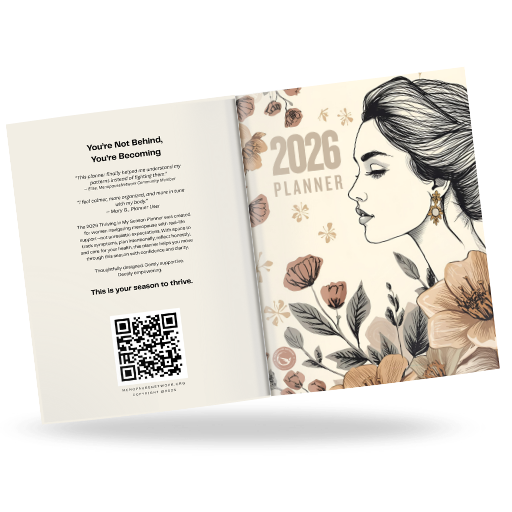
3d image of 2026 Annual Planner for Women

This is our second year offering our Annual Planner as a complimentary gift for women navigating perimenopause and menopause.

We created the 2026 Annual Planner because too many women told us the same thing:

“I feel overwhelmed, even when I am doing everything right.”

The theme “Thriving in My Season: Strong. Steady. Unstoppable.” was chosen intentionally.

Not hustle.
Not grind.
Not perfection.

Thriving.

This planner was designed to support real women with real lives and real bodies. It does not demand consistency. It supports awareness. It does not push productivity. It encourages intention.


This Planner Is Meant to Be Used, Not Perfect

This planner is our gift to you.

Own it.
Print it.
Write in it.
Skip pages.
Come back to it later.

There is no right way to use it.

Some weeks you may track everything.
Other weeks you may only jot down priorities.
Both are valid.

If it helps you feel calmer, clearer, or more grounded, it is doing its job.


Share It Forward

If you know another woman who is quietly struggling through perimenopause or menopause, share this planner with her.

That is how this community grows. Woman to woman. Season to season.

Support does not have to be loud to be powerful.


You Are Not Behind. You Are Becoming.

If you have felt scattered, overwhelmed, or disconnected from your old systems, let this be your reminder:

You are not failing.
You are adapting.
You are learning a new rhythm.

And you deserve tools that honor that.

👉 Download the 2026 Annual Planner from MenopauseNetwork.org and step into the year feeling supported, understood, and grounded in your own pace.

Why Do We Whisper “Menopause” Like It’s a Curse Word?

I once overheard a man at a dinner party say, “My wife’s going through… you know, that phase.”

He said it like she had a contagious disease.

No one asked what he meant. The women at the table exchanged glances. The men looked uncomfortable. And the conversation moved quickly onto the wine list.

That moment stuck with me—not because it was shocking, but because it was so… normal. It was a reflection of how deeply menopause stigma is embedded in everyday life.

Menopause. The word we don’t say. The reality we don’t talk about. The life chapter millions of women go through, often surrounded by people who love them—and yet still feel completely alone.

So, let’s talk about it. Loudly. Because the stigma around menopause doesn’t just hurt the women going through it. It shapes the way families, partners, and entire communities respond (or don’t).

What Is Menopause—And Why the Silence?

  • Menopause marks the end of a woman’s menstrual cycle.
  • It’s officially diagnosed after 12 consecutive months without a period.
  • The average age of menopause in the United States is around 51, though it varies among individuals (Cleveland Clinic, 2024).
  • According to the Cleveland Clinic, symptoms often start years earlier, during a phase called perimenopause, which can last anywhere from 4 to 10 years (Cleveland Clinic, 2025).

Hot flashes. Mood swings. Sleep disruptions. Brain fog. Vaginal dryness. Loss of libido.

These symptoms aren’t just “women’s issues”—they impact households, relationships, work lives, and mental health.

Still, we whisper. We joke. We dismiss.

Why?

Because we’ve been taught to fear aging, to devalue women’s bodies as they change, and to pretend that anything connected to female hormones is irrational, embarrassing, or shameful.

The History of Hushed Tones

Let’s be honest: the stigma didn’t start with our generation.

Historically, menopause has been portrayed as a form of female decline. In Victorian times, women experiencing symptoms were often diagnosed with “hysteria.” And up until the late 20th century, many medical texts described menopausal women as emotionally unstable, even unfit for work or relationships (Lock, 1993).

Is it any wonder we learned to keep quiet?

Today, despite progress in gender equality, menopause remains a stubborn blind spot.

According to a 2025 Astellas global study, 59% of people still view menopause as a taboo subject, and 57% of women said they felt unsupported at work during this transition (Astellas, 2025).

The Real-World Consequences of Menopause Stigma

Stigma isn’t just an awkward dinner party moment—it’s a public health issue.

When women feel they can’t talk openly about what they’re going through, they’re less likely to:

  • Seek medical help
  • Access accurate information
  • Get support at work or home
  • Advocate for themselves in relationships

This silence leads to increased isolation and emotional strain. It reinforces misinformation and discourages conversations that could offer support (HealthyWomen, 2025).

Worse yet, silence creates a ripple effect. Partners don’t understand what’s happening. Children notice tension but don’t know why. Coworkers misread behavior. And the woman at the center of it all begins to question her own worth.

“She Changed Overnight”: When Loved Ones Don’t Understand

Sarah, 49, told me:
“My husband thought I was angry all the time. I wasn’t. I was exhausted. I was drenched in sweat every night, my brain felt scrambled, and I hadn’t slept well in weeks. I didn’t know how to explain it—and he didn’t ask.”

Stories like Sarah’s are not rare. And while specific data on partner responses is limited, experts agree that when menopause isn’t openly discussed, loved ones may misinterpret symptoms as personality changes or emotional distance (Northwell Health, 2025).

When confusion meets silence, frustration follows.

How Menopause Stigma Affects Support at Home and Work

Imagine this:

  • Every high school student learns about menopause like they do puberty.
  • Sitcoms portray it with empathy—not punchlines.
  • Partners ask, “How can I support you?” instead of backing away in confusion.

That’s not fantasy. That’s the future we can build—if we stop whispering.

The Role of Partners and Families in Breaking the Silence

You don’t need a medical degree to support someone through menopause. What you do need:

  • Curiosity — Ask questions. Learn about the symptoms.
  • Patience — Mood swings and sleep disruptions aren’t personal attacks.
  • Empathy — This is a profound physical and emotional shift. Validate that.
  • Advocacy — Speak up when menopause is mocked or dismissed in your circles. Support awareness campaigns at work or in your community.

When partners show up—not just physically, but emotionally—it changes everything.

What Workplaces, Communities, and Cultures Must Do Next

According to a 2024 Catalyst report, more than half of menopausal women say their symptoms negatively affect their work—and yet only 11% feel comfortable discussing it with their employer (Catalyst, 2024).

We’ve built family leave policies, mental health days, and DEI initiatives. Now, it’s time to add menopause support:

  • Flexible work hours during intense symptom phases
  • Menopause education as part of HR training
  • Open forums and employee resource groups
  • Visible support from leadership

Likewise, community centers, churches, and schools—every space where people gather—can help normalize the conversation (UOC, 2025).

Let’s Talk About Menopause at the Dinner Table

Menopause isn’t a dirty word. It’s not a punchline. It’s not a reason to pity someone or tiptoe around them.

Instead, it’s a transition. A normal, biological part of life that deserves the same compassion, curiosity, and conversation we give to other health topics.

And here’s the thing: when families talk, when partners lean in instead of backing off, when workplaces adapt, when communities listen—women thrive (Menopause Global Alliance, n.d.).

Your Next Step: Be the Loud One in the Room

Here’s your challenge:

  • Say the word. Out loud. Around the dinner table. With your kids. At work.
  • Ask your partner, mother, or friend how they’re feeling—and really listen.
  • Speak up when someone makes a joke or dismisses menopause symptoms.
  • Start a conversation at your workplace or community group about how to support women during this transition.

Because change doesn’t begin with policy. It begins with voice.

Yours.

Let’s stop whispering. Let’s start owning the conversation.


Disclaimer: This content is for informational purposes only and is not a substitute for professional medical advice, diagnosis, or treatment. Always consult your healthcare provider before making any decisions about your health, especially related to medication, hormones, or sexual wellbeing. Every woman’s body is different, and what works for one may not work for another.


References

Astellas. (2025). New research reveals impact of menopause stigma. Astellas Pharma Global Newsroom. https://newsroom.astellas.com/2025-03-07-New-Research-Reveals-Impact-of-Menopause-Stigma

Catalyst. (2024). Menopause in the workplace: Addressing stigma and supporthttps://www.catalyst.org/insights/2024/address-menopause-stigma

Cleveland Clinic. (2024). Menopausehttps://my.clevelandclinic.org/health/diseases/21841-menopause

Cleveland Clinic. (2025). Perimenopause: Age, stages, signs, symptoms & treatmenthttps://my.clevelandclinic.org/health/diseases/21608-perimenopause

HealthyWomen. (2025). How the stigma of menopause and aging affect women’s experienceshttps://www.healthywomen.org/your-health/stigma-of-menopause-and-aging-affect-womens-experiences

Lock, M. (1993). Encounters with aging: Mythologies of menopause in Japan and North America. University of California Press.

Menopause Global Alliance. (n.d.). Breaking the silence: Menopause stigma around the worldhttps://menopauseglobalalliance.org/breaking-the-silence-menopause-stigma-around-the-world/

National Institute on Aging. (2024). What is menopause? U.S. Department of Health and Human Services. https://www.nia.nih.gov/health/menopause/what-menopause

Northwell Health. (2025). Why menopause stigma persists—and how to end ithttps://www.northwell.edu/katz-institute-for-womens-health/articles/women-stigmatized-over-menopause

UOC – Universitat Oberta de Catalunya. (2025). Ten actions to reduce discrimination faced by women during menopausehttps://www.uoc.edu/en/news/2025/actions-to-reduce-discrimination-faced-by-women-during-the-menopause

Where Did My Desire Go?

The Truth About Libido, Intimacy, and Menopause No One Talks About

I used to think losing my sex drive meant something was wrong with me.
No one told me it could be menopause.

If you’ve ever caught yourself wondering:
“Is this normal? Am I broken? Has menopause stolen this part of me too?” — then you’re not alone.
And more importantly, there is clarity, science, and real solutions waiting for you on the other side of this conversation.

This is not gross. It’s not shameful.
It’s menopause — one of the most powerful hormonal transitions of a woman’s life — doing what hormones do: reshape your body, your emotions, and yes, your sexuality too.

So let’s talk about it. Fully. Compassionately. Honestly.


The Emotional Reality: It Feels Like Something Disappears

There’s a quiet grief that comes with losing desire.
For some, it’s like waking up in a stranger’s body.
For others, it’s the slow realization that the spark just isn’t there anymore.

Jasmine, 49, told me:
“It wasn’t just about sex. It was about feeling like I disappeared — even to myself.”

And you think: What happened to me?

Here’s the truth: menopause doesn’t “take away” your desire because you’re flawed or undesirable.
It changes the biological and emotional landscape that once supported that desire.


The Biology of Desire: Hormones at the Helm

Menopause isn’t a single moment. It’s a transition.
Hormone levels — especially estrogen and testosterone — fluctuate wildly before settling.

Estrogen’s Role

Estrogen affects:

  • Vaginal lubrication
  • Elasticity of vaginal tissue
  • Blood flow to the genital area

As estrogen declines, tissues become thinner, drier, and more sensitive — contributing to genitourinary syndrome of menopause (GSM) (NIA, 2021).


Testosterone: The Often-Ignored Player

Though women have lower testosterone than men, the decline still affects:

  • Sexual desire
  • Arousal
  • Physical sensitivity

Studies suggest testosterone therapy may help in some cases — but only under medical supervision. (ScienceDirect, 2023)


More Than Hormones

Libido is also shaped by:

  • Stress
  • Sleep disruption
  • Body image
  • Relationship dynamics
  • Mood shifts

Libido changes are not a failure.
They’re a signal. A complicated one — but decipherable.


Vaginal Dryness Isn’t Just Uncomfortable — It Changes Desire

Pain during intimacy kills desire faster than anything.

This condition, known as atrophic vaginitis, leads to:

  • Thinner vaginal walls
  • Reduced lubrication
  • Discomfort or pain during sex

And when sex hurts?
The body shuts it down.
Desire disappears as a form of protection.

But here’s the good news — this is treatable:

  • Vaginal moisturizers
  • Water-based lubricants
  • Low-dose vaginal estrogen
  • Pelvic floor physical therapy

These are supported by clinical guidelines and widely recommended. (Mayo Clinic, 2023)

Comfort is not optional. It’s foundational.


Libido Isn’t Just Physical — It’s Deeply Emotional

Desire rises from:

  • Feeling attractive
  • Feeling connected
  • Feeling safe
  • Feeling present

Stress, anxiety, poor sleep, and body image issues can all affect libido (Ohio State Health, 2025).

Sexual desire is an emotional and relational dialogue — not just physical urge.
That’s why communication becomes core to rekindling intimacy.


Your Body Is Not Broken

Menopause does not mark the end of your sexuality.
It marks a shift in how your sexuality expresses itself.

Some women report libido returning post-menopause when they:

  • Address physical discomfort
  • Redirect expectations
  • Communicate needs
  • Find new ways to connect

Sex after menopause can be:

  • Comfortable
  • Desired
  • Fulfilling
  • Exploratory

6 Realistic, Science-Backed Ways to Reclaim Desire

1. Treat Vaginal Symptoms Directly

Use:

  • Vaginal moisturizers
  • Lubricants
  • Low-dose vaginal estrogen
    (Recommended by menopause specialists for GSM)

2. Discuss Hormone Therapy Thoughtfully

  • HRT can relieve systemic symptoms
  • Local estrogen is often considered safe and effective for vaginal comfort

3. Explore Testosterone — Carefully

  • May support libido in some women
  • Only under medical guidance

4. Strengthen Emotional & Relational Connection

Try:

  • Open conversations
  • Couples therapy
  • Mindful touch
  • Redefining intimacy

Relationship quality is directly linked to sexual satisfaction (Menopause.org)

5. Address Lifestyle Factors

  • Reduce stress
  • Prioritize sleep
  • Move your body
  • Nourish yourself

Lifestyle changes can improve libido and energy (Oh Hello Meno, 2024)

6. Seek Support

  • See a menopause-literate clinician
  • Work with a therapist who gets it

Specialized care leads to better outcomes (Mayo Clinic, 2023)


If Your Desire Has Returned — That’s Real Too

Not every woman loses libido.
For some, midlife becomes the most empowered, exploratory sexual chapter of their lives.

Sexuality in midlife can be:

  • More attuned
  • More authentic
  • Less performance-based

Menopause Isn’t the End — It’s a New Chapter

Desire isn’t gone. It’s evolving.

You deserve:

  • Comfort
  • Pleasure
  • Connection

And you are not alone.


Your Next Step

If you’re struggling with desire, don’t wait for it to “just come back.”

Do this today:

  • Talk to your doctor
  • Ask about vaginal estrogen
  • Open the conversation with your partner

Your intimacy isn’t gone — it’s evolving. And you deserve to feel connected again.


Disclaimer: This content is for informational purposes only and is not a substitute for professional medical advice, diagnosis, or treatment. Always consult your healthcare provider before making any decisions about your health, especially related to medication, hormones, or sexual wellbeing. Every woman’s body is different, and what works for one may not work for another.


References

50 Powerful Resolutions to Help #WomenOver40 Feel Stronger, Healthier, and More in Control in 2026

Perimenopause and menopause aren’t just chapters in your life — they’re a whole new era of strength, growth, and self-discovery. While the hot flashes, mood swings, and brain fog might try to steal the spotlight, the truth is, this season can be one of the most powerful and transformative of your life.

The key? Taking back control.

These 50 powerful resolutions are designed to help you do exactly that. They’re not just random “good ideas” — they’re tried-and-true strategies that real women have used to feel stronger, healthier, and more confident through every stage of this hormonal transition. From boosting self-care and fitness to deepening relationships, revamping your career, and protecting your mental well-being, these resolutions address every aspect of your life.

No unrealistic goals. No perfection required. Just practical, simple steps that make a big impact. You don’t have to do them all — start with one or two that resonate with you and build from there. This isn’t about “fixing” yourself. It’s about embracing your power and moving into this stage of life with clarity, courage, and confidence.

Ready to feel more in control this year? Let these 50 resolutions be your guide. It’s your time to thrive — and it starts now.

Self-Care & Well-Being Resolutions

  1. Prioritize “Me Time”: Schedule one self-care activity each week (bubble bath, massage, or meditation).
  2. Practice Daily Gratitude: Start or end each day by writing down three things you’re thankful for.
  3. Sleep Like a Queen: Create a bedtime routine to improve sleep hygiene (no screens, lavender spray, and a calming tea).
  4. Hydrate with Purpose: Drink at least 8 glasses of water daily to support hormonal balance.
  5. Commit to Joyful Movement: Dance, stretch, walk, or join a fun fitness class at least 3 times a week.
  6. Cut Down on Sugar & Caffeine: Reduce stimulants that trigger hot flashes and mood swings.
  7. Say “No” Without Guilt: Prioritize your time by setting healthy boundaries.
  8. Learn to Meditate: Take 5-10 minutes a day to breathe deeply and quiet your mind.
  9. Pamper Your Skin: Invest in a skincare routine that supports aging gracefully (hello, retinol!).
  10. Schedule Regular Health Checkups: Stay on top of mammograms, bone density scans, and routine bloodwork.

Relationship & Romance Resolutions

  1. Revive Date Nights: Plan a monthly date night with your partner to rekindle intimacy.
  2. Open Up About Menopause with Your Partner: Help them understand what you’re experiencing.
  3. Set Aside Weekly Family Connection Time: Schedule family dinners, game nights, or outings.
  4. Reconnect with Friends: Call an old friend or schedule a girls’ night out at least once a month.
  5. Revamp Your Intimate Life: Explore products that support intimacy (lubricants, vaginal moisturizers, etc.).
  6. Practice Radical Honesty: Speak up when something bothers you instead of bottling it up.
  7. Celebrate Your Milestones Together: Plan trips, experiences, or celebrations with family and friends.
  8. Put Down the Phone: Have device-free dinners to create deeper connections with family.
  9. Schedule a Couples’ Wellness Retreat: Prioritize a weekend away together to rest, reconnect, and refocus.
  10. Ask for Help When You Need It: No more being a superhero. Let others help when you’re feeling overwhelmed.

Career & Work Resolutions

  1. Ask for a Raise or Promotion: Don’t let self-doubt hold you back—advocate for your worth.
  2. Invest in a New Skill or Certification: Take a course or training to future-proof your career.
  3. Create a Better Work-Life Balance: Set specific work hours and avoid burnout.
  4. Set Boundaries with Work Emails: Turn off email notifications after work hours.
  5. Take a Mental Health Day: Give yourself permission to take time off when you need it.
  6. Update Your Resume & LinkedIn Profile: Get it ready for new career opportunities.
  7. Build Your Personal Brand: Position yourself as an expert in your field.
  8. Mentor a Younger Colleague: Share your wisdom and empower the next generation of women.
  9. Speak Up in Meetings: Make your voice heard in every room you’re in.
  10. Invest in an Ergonomic Workspace: Upgrade your chair, desk, and screen setup for comfort and health.

Health, Nutrition & Fitness Resolutions

  1. Switch to a Whole-Foods Diet: Ditch processed foods and prioritize fresh fruits, vegetables, and lean proteins.
  2. Try the Mediterranean Diet: Support heart and brain health with this menopause-friendly eating plan.
  3. Incorporate More Plant-Based Meals: Swap in at least one meat-free meal each week.
  4. Take Daily Supplements: Check in with your doctor about adding Vitamin D, calcium, or omega-3s.
  5. Get a Hormone Checkup: Understand what’s happening in your body with a full hormonal panel.
  6. Train for a Fun Run, 5K, or Walk: Challenge yourself with a fitness goal that supports heart health.
  7. Try Weight Lifting: Build muscle and improve bone density with resistance training.
  8. Stretch Daily: Loosen up tight muscles and relieve stress with gentle stretching routines.
  9. Cut Back on Alcohol: Reduce wine nights to prevent hot flashes, night sweats, and better sleep.
  10. Address Mental Health Head-On: Seek therapy, coaching, or support for emotional wellness.

Personal Growth & Mindset Resolutions

  1. Adopt a “Growth Mindset”: View failures as opportunities to learn and grow.
  2. Let Go of Perfectionism: Progress is better than perfection, so celebrate small wins.
  3. Read One Personal Development Book a Month: Gain wisdom, perspective, and fresh motivation.
  4. Keep a Menopause Journal: Write down symptoms, moods, and triggers to track patterns.
  5. Challenge Your Comfort Zone: Try something new every month (new hobby, food, or class).
  6. Forgive Yourself: Let go of past mistakes and focus on self-compassion.
  7. Unfollow Negative Influences on Social Media: Create a positive, inspiring social feed.
  8. Embrace Aging: Stop chasing youth and focus on embracing your unique beauty and experience.
  9. Focus on Progress, Not Perfection: Celebrate small wins, not just big ones.
  10. Invest in Yourself: This could mean therapy, coaching, courses, or even new clothes that make you feel amazing.

These resolutions aim to help women thrive in all areas of life — self-care, relationships, career, family, health, and personal growth. No need to tackle them all at once. Choose the ones that resonate with you most and start the year with renewed purpose.


Pro Tips for Success: How to Make Your Resolutions Stick and Thrive All Year Long

So, there you go — you’ve got your list of powerful resolutions — now what? If you’ve ever made New Year’s goals before, you know that setting them is the easy part. The challenge comes with sticking to them. But don’t worry — you don’t have to rely on willpower alone. With the right strategy, you can turn these resolutions into lasting habits that fuel your mental, physical, and emotional well-being.

Here are four tried-and-true techniques to make your menopause or perimenopause resolutions actually stick this year.

1. Start Small (Because Small Wins Add Up)

Tip: Pick 1-3 resolutions and make them part of your daily or weekly routine.

One of the biggest mistakes people make is taking on too much, too soon. It’s tempting to tackle 10 big changes at once, but that’s a recipe for burnout. Instead, start small. Focus on 1-3 resolutions that feel the most important to you right now.

For example:

  • If you want to improve sleep, start by establishing a calming bedtime ritual 3 nights a week instead of every night.
  • If your goal is to exercise more, aim for two 20-minute workouts a week to start.

This approach makes it easier to build momentum, and once these small wins become habits, you can stack on new goals. Progress over perfection is the name of the game. Each small step forward is a big deal.

Why It Works:
Starting small avoids the all-or-nothing trap. It also makes it easier for your brain to build a habit because the task feels achievable — and every win builds confidence.

2. Track Your Progress (Yes, Write It Down!)

Tip: Write down your wins and progress as a form of self-motivation.

Ever notice how satisfying it feels to cross something off a to-do list? That little “check” releases dopamine, a feel-good chemical that fuels motivation. Tracking your progress works the same way.

Here’s how to do it:

  • Keep a small journal, planner, or notes app where you can track daily or weekly progress.
  • Log small wins, like “stretched for 10 minutes today” or “only had one glass of wine instead of two.”
  • Celebrate these moments as proof of your growth — even if they seem small.

You can also use visual tools like a goal tracker app, sticker chart, or habit-tracking calendar to see your streaks. Seeing a week of consistent progress feels good and can motivate you to keep going.

Why It Works:
Tracking progress isn’t just for kids and goal-setting gurus — it’s for everyone. By making progress visible, you stay motivated and more aware of how far you’ve come. Plus, if you ever feel like you’re “failing” at a goal, looking back on past wins can be a powerful reminder that you’re still moving forward.

3. Get an Accountability Partner (Don’t Go It Alone)

Tip: Ask a friend, spouse, or family member to hold you accountable.

We are social creatures, and there’s something about telling someone your goals that makes them feel more real. Whether it’s a spouse, sister, best friend, or coworker, having an accountability partner can be a game-changer. They can check in on you, celebrate your wins, and gently remind you to get back on track when you veer off course.

How to find a great accountability partner:

  • Choose someone who will encourage you, not shame you.
  • Be clear about what support you need — a simple “Can you check in on me every Friday?” is a good start.
  • Make it a two-way street. Maybe they have goals too, and you can both support each other.

If a friend or partner isn’t available, consider joining an online group for women navigating menopause or health and wellness groups. These communities are often filled with supportive people on a similar journey.

Why It Works:
It’s hard to let someone down, especially if they’re cheering you on. Knowing that someone is watching your progress keeps you accountable. Plus, when you share your wins with someone, you reinforce the behavior and make it feel even more rewarding.

4. Be Kind to Yourself (Because Perfection Isn’t Required)

Tip: If you slip up, that’s OK. Restart with fresh energy the next day.

You’re going to slip up. Period. It’s part of the process. Maybe you miss a workout, hit snooze on your meditation, or have a second piece of cake. Instead of spiraling into “I’ve failed” thinking, reframe it as a reset.

Here’s how:

  • Instead of saying, “I failed my goal” → Say, “I had an off day, and I’ll try again tomorrow.”
  • Be kind to yourself, just like you would to a friend who’s struggling.
  • View every slip-up as data, not a disaster. Ask: “What caused this?” and “How can I plan differently next time?”

If you aim for perfection, you’ll always be disappointed. If you aim for progress, you’ll keep moving forward. Every day is a new opportunity to try again. Menopause is already a time of physical and emotional changes, so give yourself grace as you adjust to your new normal.

Why It Works:
Self-compassion isn’t just “being nice” to yourself. Research shows that people who practice self-compassion are more likely to achieve their goals because they avoid the guilt-shame cycle. When you forgive yourself and keep moving forward, you build resilience and learn to thrive — even when things don’t go perfectly.


🔥 Your 4-Step Recap for Success

  1. Start Small: Pick 1-3 realistic resolutions to focus on.
  2. Track Your Progress: Write down wins to see how far you’ve come.
  3. Get an Accountability Partner: Ask a friend, family member, or group to support you.
  4. Be Kind to Yourself: Slipped up? No problem. Reset, restart, and keep going.

This is your year to feel stronger, healthier, and more in control. These pro tips will help you make these resolutions stick — not just for January, but for life. Small changes, consistent progress, and a little grace go a long way.

Holiday Stress and Perimenopause: How to Stay Balanced in the Busiest Season

Let’s be honest—this time of year can feel like a lot. The holidays come in hot, full of expectations, full calendars, and let’s face it… a whole lot of emotional labor. And if you’re in perimenopause? Everything just feels louder, heavier, and harder to bounce back from.

One minute you’re wrapping gifts or making your famous side dish, and the next, you’re snapping at someone you love or lying awake at 2am wondering what happened to the version of me that could handle all this?

You’re not imagining it. Hormones are shifting in a big way during perimenopause, and your body becomes way more sensitive to stress. So when December rolls around with all its chaos, it’s no surprise if your symptoms suddenly feel turned up to 100.

But here’s the good news: once you understand what’s going on inside your body—and start making a few small changes—you can feel more grounded, calm, and in control. Even when everything around you feels busy and demanding.

Let’s walk through why stress hits harder during this phase, how to protect your energy (without guilt), and a few practical ways to feel better fast.


Why Does Stress Feel So Intense Right Now?

It all comes down to hormones. During perimenopause, your estrogen and progesterone are rising and falling like a hormonal rollercoaster. And when those two are out of balance, your body has a much harder time managing cortisol—your main stress hormone.

When cortisol goes unchecked, it can make everything worse:

  • Hot flashes get more frequent and intense
  • Sleep becomes elusive (hello, 3am wake-ups)
  • Mood swings, anxiety, irritability — all amplified
  • Headaches and fatigue show up more often
  • And even small things can feel completely overwhelming

Add holiday pressure to that mix, and it’s no wonder you’re feeling tapped out. But you don’t have to white-knuckle your way through it.


3 Easy Strategies That Actually Help

1. Build in Micro-Breaks Before You Crash

Instead of waiting until you’re totally fried, try weaving little “stress resets” into your day:

  • Take a 5-minute breather after a meeting or errand
  • Step outside for a walk (even just around the block)
  • End your day with a warm shower, candles, and zero screens
  • Block out “do nothing” evenings on your calendar—yes, literally schedule them

These tiny moments of rest are like pressure valves for your nervous system.

2. Clear the Hidden Stress Clutter

Not all stress is emotional—some of it is just too much sensory input. Try lightening the load:

  • Dim overhead lights and turn on softer lamps
  • Play calm background music instead of noisy TV
  • Skip the over-the-top decorations and go simple
  • Shop online or at off-hours to avoid the crowds

Your environment can either wind you up—or help you exhale.

3. Practice the Pause Before Saying Yes

We’re so used to saying yes automatically—especially around the holidays. But this season, give yourself permission to pause. Ask yourself:

  • Do I actually want to do this?
  • Will this give me energy—or drain it?
  • Am I doing this out of guilt, habit, or pressure?

You get to choose what’s right for your body this year. Saying no isn’t selfish—it’s smart.


How to Set Boundaries Without Guilt

Perimenopause is a time when your body is asking for more care—not more chaos. So it’s OK to shift how you show up.

Here are a few boundary swaps to try:

  • Trade late-night parties for cozy evenings and earlier bedtimes
  • Host just one event instead of feeling obligated to do it all
  • Make it a potluck and let others pitch in (you don’t need to be a one-woman show)
  • Be upfront and honest: “This year, I’m keeping things simple so I can feel my best.”

You deserve to enjoy the holidays without running yourself ragged. This year, let’s do it differently—with more ease, more calm, and more space to just be.


Please remember: This information is for educational purposes only and is not intended to replace professional medical advice, diagnosis, or treatment. Always consult with your healthcare provider before making any changes to your health routine, especially if you have existing health conditions or are taking medications. What works for one person may not work for another, and your individual health needs are unique to you.